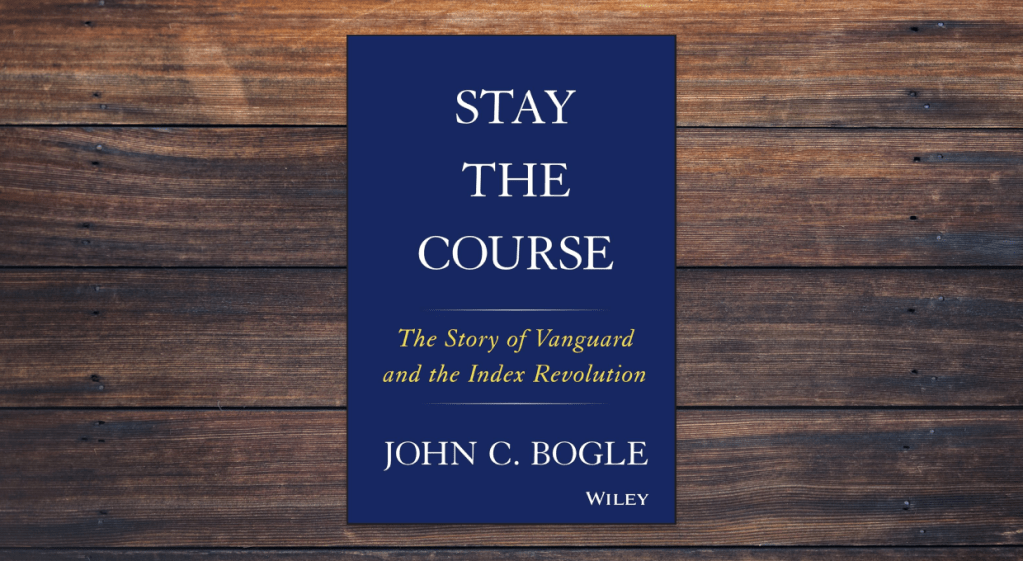
There are very few figures in the history of American finance who have done more concrete good for ordinary investors than John C. Bogle. The founder of Vanguard and the creator of the first index mutual fund available to individual investors, Bogle spent his career fighting a sustained and often lonely battle against an industry that profited handsomely from complexity, high fees, and the systematic extraction of returns from the people it claimed to serve. Stay the Course: The Story of Vanguard and the Index Revolution, published in 2018, is his final book, completed in the last year of his life and published just months before his death in January 2019. It is part memoir, part institutional history, part investment philosophy, and entirely characteristic of the man who wrote it: direct, principled, occasionally combative, and animated throughout by a genuine conviction that ordinary investors deserve better than what the financial industry has historically given them.
Who Is John C. Bogle?
John Clifton Bogle was born on May 8, 1929, in Montclair, New Jersey, into a family whose finances were devastated by the stock market crash of that same year. He attended Blair Academy on a scholarship and later Princeton University, where his senior thesis on the mutual fund industry planted the intellectual seeds that would eventually grow into Vanguard. He graduated in 1951 and joined Wellington Management Company, where he rose to become chief executive before a failed merger he championed led to his dismissal in 1974.
That professional setback proved to be the pivot point of his career and, arguably, of American investing. In 1974 Bogle founded the Vanguard Group with a novel organizational structure: the fund company would be owned by its funds, which were in turn owned by their shareholders. This mutual structure eliminated the profit motive that drives most financial companies to extract as much in fees as possible from their customers, because at Vanguard the customers were the owners. In 1976 he launched the First Index Investment Trust, later renamed the Vanguard 500 Index Fund, the first index mutual fund available to individual investors. It was initially derided by competitors as Bogle’s Folly and mocked as un-American for its implicit acceptance of average returns. It has since become the largest mutual fund in the world by assets.
Bogle received numerous honors throughout his career including the Woodrow Wilson Award from Princeton, and he was named by Time magazine as one of the world’s one hundred most powerful and influential people. He stepped down as Vanguard’s CEO in 1996 but remained chairman of the Vanguard board until 1999 and continued writing, speaking, and advocating for investor interests until his death. He authored twelve books, of which Stay the Course was the last.
What the Book Is About
Stay the Course is organized around two interwoven narratives: the history of Vanguard as an institution and the intellectual and philosophical development of the investment principles that Bogle spent his career advocating. These two threads are inseparable because Vanguard itself was conceived as the institutional embodiment of those principles, an attempt to build a financial company whose structure guaranteed that its interests were aligned with its shareholders rather than opposed to them.
The book covers the founding of Vanguard in detail, including the internal battles, the industry skepticism, and the years of underperformance and ridicule that preceded the eventual vindication of the index fund concept. It examines the development of the mutual ownership structure that distinguishes Vanguard from its competitors and explains why Bogle believed that structure was not just a business model but a moral imperative in an industry that he felt had lost its way.
It also addresses the transformation of the financial industry over the course of Bogle’s career, the rise of speculation over investment, the proliferation of complex financial products, the growth of trading volume relative to long-term holding, and the increasing dominance of institutional investors whose incentives diverge from those of the individual savers on whose behalf they nominally act. Bogle’s analysis of these trends is pointed and often sharp, reflecting a man who had spent decades watching an industry he loved move in directions he believed were harmful to its ultimate beneficiaries.
The final sections of the book address the future of index investing and the challenges and opportunities facing Vanguard and the broader fund industry in the years ahead. Bogle was candid in this section about concerns regarding the concentration of ownership that large index funds create and the implications of that concentration for corporate governance, a set of concerns he felt were not receiving adequate attention from the investment community.
Lessons Readers Can Take Away
The most enduring lesson of Stay the Course, both as the book’s explicit message and as the summation of Bogle’s life’s work, is deceptively simple: buy a broadly diversified, low-cost index fund, reinvest the dividends, and do not sell. The entire apparatus of market research, stock picking, tactical asset allocation, sector rotation, and market timing that the financial industry has built and sold to investors over decades generates enormous fees and produces, in aggregate, returns that are lower than simply holding the market would produce. The evidence for this, which Bogle reviews throughout the book with characteristic thoroughness, is about as close to settled as anything in investment science.
The practical implication for any reader building a long-term investment portfolio is that the most important financial decision you can make is not which stock to buy or which fund manager to trust. It is establishing the habit of regular, automatic contributions to a low-cost index fund and maintaining that habit through market cycles without making changes in response to short-term performance. The simplicity of that prescription is not a concession to readers who cannot handle complexity. It is the actual answer, supported by decades of evidence.
A second lesson concerns the compounding cost of investment fees over long periods. Bogle was more persistent and more detailed on this point than almost any other financial writer, and the numbers he marshals are striking. A difference of one percentage point in annual fees between two otherwise identical funds, maintained over forty years of saving and investing, can consume a third or more of the ending portfolio value. That is not a trivial difference. It is the difference between financial security and something substantially less, and it flows entirely from the fee structure of the products you choose rather than from any investment skill or lack thereof on your part.
A third lesson is about the distinction Bogle consistently draws between investment and speculation. Investment, in Bogle’s framework, is the long-term participation in the earnings growth and dividend payments of productive enterprises. Speculation is the attempt to profit from price movements in securities over periods short enough that earnings growth plays little role. Most of what passes for investing in American financial culture, including most of what is sold by the financial services industry, is closer to speculation than to investment. Understanding that distinction changes how you evaluate financial products and financial advice.
A fourth lesson comes from the institutional history sections of the book and concerns what Bogle calls the character of an organization. Vanguard’s structural advantage, its mutual ownership and resulting cost discipline, did not produce results instantly. It took years of underperformance relative to more aggressively marketed competitors before the mathematics of low costs began to show clearly in long-term results. The lesson for individual investors is analogous: the right financial strategy produces results that are not always immediately visible and that require the patience to stay committed through periods when other approaches appear to be working better.
Criticisms of the Book
Stay the Course is a genuine and valuable contribution to investment literature, but it has several limitations worth acknowledging.
The most frequent criticism is that the book is more institutional history and personal memoir than investment guide. Readers who come to it expecting a practical manual for applying Bogle’s principles will find extended sections on Vanguard’s internal politics, board room disputes, and corporate governance that are interesting as history but not directly applicable to their own financial decisions. For a more focused and concise statement of Bogle’s investment philosophy, The Little Book of Common Sense Investing, reviewed on this site, is a better starting point.
A second criticism is that Bogle’s self-assessment throughout the book, while admirably honest about his mistakes and failures, is also inevitably shaped by his personal stake in the history he is telling. He is the protagonist of this story, and while he demonstrates genuine critical self-reflection in several places, the narrative is necessarily filtered through his perspective. The people and decisions he portrays less favorably do not have the opportunity to offer their own accounts.
A third criticism is that the concerns Bogle raises about index fund concentration in the final sections of the book, while intellectually serious and worth taking seriously, are not developed with the same rigor as the rest of the argument. The observation that very large index fund ownership creates corporate governance challenges is a legitimate and increasingly important debate in financial economics, but the book gestures toward the problem more than it works through the implications.
A fourth criticism is simply that the book assumes some familiarity with the history of the financial industry and with basic investment concepts. Readers who are entirely new to investing may find the institutional history sections less accessible than the investment philosophy sections.
The book’s core argument, in plain English
Strip away the memoir and the institutional history, and Bogle’s argument fits in a paragraph: investment costs are the only thing about a fund you can know in advance, and they compound against you with the same relentless math that compounds returns in your favor. Everything the industry sells — star managers, tactical shifts, clever strategies — is an attempt to overcome a cost hurdle that the data says almost nobody clears consistently. The index fund doesn’t win by being brilliant. It wins by refusing to play a loser’s game.
The deeper point, and the one that makes this a book rather than a pamphlet, is that the index fund was a structural fix, not just a product. Bogle could only create it because Vanguard’s mutual ownership structure — the fund shareholders own the management company — removed the profit motive that makes every other fund company a cost-maximizer. Our guide to index funds explains the mechanics; Bogle’s book explains why the mechanics required a revolution in who owns the firm.
Two lessons I’d highlight for the skeptical reader
First, Bogle’s case doesn’t require you to believe markets are perfectly efficient — only that costs are certain and outperformance is not. This is the steelman that converts skeptics: even if you’re convinced some managers can beat the market, you cannot identify them in advance with any reliability. But you can identify, to the penny, which fund will charge you the least while you try. Cost is a fact; outperformance is a hope. Bet on the fact.
Second, the book is a case study in how long good ideas take — and how being right too early looks identical to being wrong. The first index fund was mocked as ‘Bogle’s folly,’ gathered almost nothing for years, and survived only because Vanguard’s structure meant Bogle didn’t need to justify it to profit-demanding owners. The lesson isn’t just ‘stay the course’ as an investor. It’s that the right structure is what lets you stay the course long enough for the world to catch up.
Who should read Stay the Course — and what to read first
Think of Bogle’s books as a sequence, not a menu. The Little Book of Common Sense Investing is the entry point — 200 pages, pure investment case, no memoir. Enough is the moral philosophy. Stay the Course is the capstone: the full story of how the idea survived decades of ridicule to remake the industry. You don’t need all three, but they build on each other.
So: if you already own index funds and want to understand the man and the institution behind them — especially if you’re a Vanguard customer curious about that odd ownership structure — read Stay the Course. It’s the director’s cut for readers who already believe the thesis and want the complete history. (New to Bogle? The ‘Should You Buy This Book?’ section below has the right starting point.)
Should You Buy This Book?
Yes, particularly for readers who have some existing familiarity with Bogle’s investment philosophy and want to understand its origins, the institutional history that shaped it, and the man who spent his life advocating for it.
For readers who are new to index fund investing or to Bogle’s work, The Little Book of Common Sense Investing, also reviewed on this site, is the more appropriate starting point. It makes the essential case for low-cost index investing in a more focused and accessible format. Stay the Course is the richer and more complete account of how that case was developed and what it took to make it, and it rewards readers who bring some prior context to it.
A Random Walk Down Wall Street by Burton Malkiel provides the academic and theoretical foundation for the efficient market argument that underlies Bogle’s practical recommendations and pairs naturally with this book. Enough by Bogle, also reviewed here, addresses the philosophical and ethical dimensions of his thinking in ways that complement the institutional focus of Stay the Course.
For anyone who wants to understand how the index fund revolution happened and what it means for ordinary investors, this book is essential reading.
Final Thoughts
John Bogle finished Stay the Course knowing he was near the end of his life, and the book has the quality of a final statement from someone who has spent decades working toward something and wants to be sure the record is complete. It is not a polished or perfectly structured book. It is an honest one, written by a man who built something genuinely important, fought for principles he believed in against sustained industry opposition, and wanted to explain why he did it and what he hoped it would mean for the people it was meant to serve.
The index fund revolution that Bogle started has transferred an enormous and still-growing sum of money from the pockets of financial industry intermediaries into the retirement accounts of ordinary American savers. That is not a small thing. The arithmetic of low costs, applied consistently over millions of accounts across decades of compounding, represents one of the most significant improvements in individual financial welfare that any single person has produced in modern American economic history.
Stay the Course is both the title of the book and the summation of the investment philosophy it describes. Buy broadly diversified, low-cost index funds. Reinvest the dividends. Maintain your allocations through market cycles. Do not try to time the market or select individual winners. Pay as little in fees as you possibly can. And stay the course. It is not complicated advice. But as Bogle spent his entire career demonstrating, the simplicity of the advice is exactly why it works, and exactly why an industry that profits from complexity has consistently worked so hard to convince you that you need something more.









 Winchell House
You must be logged in to post a comment.