
In a financial industry that rewards confidence, consensus, and the appearance of certainty, James Montier has spent his career doing something considerably less comfortable: telling investors, including professional ones, that most of what they believe about their own abilities is wrong. He is a behavioral finance researcher, strategist, and author whose work sits at the intersection of academic psychology, neuroscience, and practical investment management. For anyone trying to understand why smart people make bad financial decisions, and what to do about it, Montier is one of the most important voices in the field.
Early Life and Education
James Montier was born and raised in the United Kingdom. He studied economics at Portsmouth University and went on to earn a master’s degree from the University of Warwick, and is today a visiting fellow at the University of Durham. His academic background is in economics rather than psychology, but his intellectual interests pulled consistently toward the behavioral side of financial decision-making at a time when that field was still considered somewhat outside the mainstream of serious investment research.
His entry into the professional world coincided with a period of growing institutional interest in behavioral finance following the foundational work of Daniel Kahneman, Amos Tversky, and Richard Thaler, whose research was beginning to attract serious attention in investment circles. Montier recognized earlier than most practitioners that the implications of behavioral research for investment management were not merely academic but deeply practical, and he built his career around making those implications accessible and actionable for working investors.
Career in Investment Research
Montier built his professional reputation as a global equity strategist, first at Dresdner Kleinwort and later at Société Générale, the French multinational investment bank. At both institutions his research reports attracted a devoted following among institutional investors, portfolio managers, and financial academics who found his combination of rigorous behavioral science and practical investment application unusually valuable.
His research notes at Société Générale in particular became some of the most widely circulated documents in professional investment circles during the mid-2000s. They were distinctive in several ways: they engaged seriously with academic research rather than simply citing it superficially, they were willing to reach conclusions that contradicted the prevailing consensus, and they were written with unusual clarity and directness for a genre that often prioritizes the appearance of sophistication over genuine communication. Investors who read his work regularly described it as genuinely changing how they thought about decision-making and market behavior.
In 2009 Montier joined GMO, the Boston-based investment management firm founded by Jeremy Grantham. GMO is known in the investment world for its long-term value orientation, its rigorous approach to asset allocation, and its willingness to take contrarian positions that diverge significantly from market consensus when its analysis suggests the consensus is wrong. It is an institution whose intellectual culture fits naturally with Montier’s own disposition toward evidence-based thinking and skepticism of popular narratives, and he has remained there as a member of the asset allocation team.
Books and Written Work
Montier has written several books on behavioral finance and investment management, ranging from technical academic texts to accessible popular works. His two most widely read titles are The Little Book of Behavioral Finance and The Little Book of Behavioral Investing, both published in 2010 as part of Wiley’s Little Book series and both reviewed on this site.
The Little Book of Behavioral Finance provides a broad introduction to the major cognitive biases that lead investors astray, drawing on decades of academic research to explain the mechanisms behind overconfidence, herding, loss aversion, and related phenomena. It is written for a general audience and remains one of the most accessible entry points into behavioral finance available.
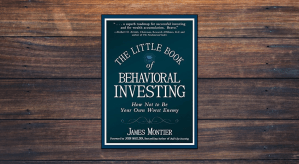
The Little Book of Behavioral Investing, subtitled How Not to Be Your Own Worst Enemy, covers overlapping territory with a more specific focus on how these biases manifest in actual investment decisions and what structural changes to investment process can mitigate their influence. Together the two books form an unusually coherent and practically useful guide to the psychological dimension of investing.
His longer and more technically demanding work, Behavioural Investing: A Practitioner’s Guide to Applying Behavioural Finance, published in 2007, is aimed at professional investors and covers the same territory with considerably greater depth and more specific application to portfolio construction and investment process design. It is widely used in professional investment management settings and has influenced how a generation of portfolio managers think about decision-making and risk.
He has also published extensively through GMO’s research platform, producing white papers and client letters on topics ranging from valuation and asset allocation to the limits of quantitative investing and the behavioral foundations of market cycles. These publications are available through GMO’s website and have reached a wide audience within the investment profession.

Core Ideas and Intellectual Contributions
Montier’s most important intellectual contribution is his sustained and rigorous application of behavioral science to investment practice. While behavioral finance as an academic discipline was well-established by the time he became prominent, the translation of that research into practical guidance for working investors was less developed, and Montier was among the first practitioners to do that translation work seriously and at scale.
His treatment of overconfidence is particularly important and particularly well-documented. The research he reviews consistently shows that professional investors, including highly educated and extensively experienced ones, systematically overestimate the accuracy of their own predictions and the quality of their own judgment. Forecasters who express ninety percent confidence in their predictions are right substantially less than ninety percent of the time. Analysts who construct detailed valuation models produce estimates with far wider error bands than their stated confidence levels imply. Montier does not present this as a character flaw or an intelligence failure. He presents it as a feature of human cognition that is shared universally and that requires structural solutions rather than simply greater effort or greater self-awareness.
His work on the value of systematic, rules-based investment processes as a defense against behavioral biases connects directly to the broader case for passive, low-cost, broadly diversified investing. If the primary source of investment underperformance is not insufficient analysis but the behavioral errors that accompany active decision-making, then strategies that minimize the number and frequency of active decisions are not just philosophically sound but specifically designed to address the actual mechanism of failure. This argument, which Montier develops with considerable supporting evidence, provides a behavioral foundation for the index fund investing philosophy advocated by figures like John Bogle and Burton Malkiel.
His skepticism toward financial forecasting is another consistent thread running through his work. Montier has documented extensively the poor track record of market predictions, including predictions made by the most credentialed and well-resourced analysts in the profession, and he is unsparing in his conclusion that the confidence with which most market commentary is delivered is wildly disproportionate to the actual predictive accuracy of the people delivering it. This critique has made him a valuable counterweight to the financial media’s appetite for confident directional calls about where markets are headed.
Influence and Legacy
Montier’s influence is difficult to quantify precisely but is clearly significant within the investment profession. His research at Société Générale shaped how a generation of institutional investors thought about behavioral finance, and his books have introduced the field to thousands of individual investors who might not otherwise have encountered it.
His work at GMO has contributed to one of the more intellectually distinctive investment firms in the world, an institution that has consistently been willing to make unfashionable calls based on valuation analysis and long-term thinking rather than chasing near-term performance. That institutional commitment to evidence-based, behaviorally informed investing reflects the same principles that run through Montier’s written work.
For readers building a serious financial education, engaging with Montier’s books is a valuable and underutilized step. Most personal finance education focuses on the mechanics of saving, investing, and debt management. It rarely addresses the cognitive architecture that determines whether people can actually execute those mechanics consistently over time. Montier’s work fills that gap with more rigor and more depth than almost anything else available in the accessible investment literature.
The Seven Immutable Laws of Investing
Montier once distilled his whole philosophy into seven laws, and they are worth knowing verbatim, because almost every investment mistake you will ever make breaks one of them. Always insist on a margin of safety for your principal. This time is never different. Be patient and wait for the fat pitch. Be contrarian. Risk is the permanent loss of capital, never a number. Be leery of leverage. Never invest in something you do not understand.
Notice what is missing. There is no law about finding great companies, timing the market, or reading earnings calls more carefully. Every law is a restraint on the investor, not a claim about the market. Montier’s point is that your behavior is the portfolio. The market does not need to be beaten; it needs to be survived, and survival is a discipline problem. Tape the list somewhere you will see it the next time you feel clever.
Margin of Safety Is a Behavioral Tool, Not a Math Trick
Most investors hear “margin of safety” and think of a valuation formula. For Montier it is something closer to a humility device. His research on overconfidence shows that forecasters who claim 90 percent confidence are right far less than 90 percent of the time, and that the error bars on every valuation model are wider than the person who built it admits. The margin of safety is what protects you from the fact that you are wrong more often than you think.
This is why Montier pairs margin of safety with patience. Waiting for the fat pitch is the same discipline expressed as behavior: do nothing until the odds and the price are both in your favor, then act decisively. The two laws are one idea wearing two hats. Investors who treat margin of safety as arithmetic resize their models; investors who treat it as behavioral knowledge resize their expectations of themselves.
Where to Start
For readers new to Montier’s work, The Little Book of Behavioral Investing is the most practical starting point. It is short, accessible, and focused on the specific investment behaviors that most reliably destroy returns. The Little Book of Behavioral Finance covers similar ground with a somewhat broader lens and is equally accessible.
Both books pair naturally with Thinking, Fast and Slow by Daniel Kahneman which provides the most comprehensive account of the cognitive mechanisms underlying the biases Montier describes. A Random Walk Down Wall Street by Burton Malkiel provides the market efficiency framework that explains why those biases are so costly in investment contexts. And Thinking in Bets by Annie Duke addresses decision quality under uncertainty from a complementary angle.
Together these books form the core of a serious education in the psychology of financial decision-making, which is ultimately as important as any technical knowledge about investment products or strategies. Understanding why you make the decisions you make is the prerequisite for making better ones, and James Montier has done more than almost anyone to make that understanding accessible to working investors.









 Winchell House
You must be logged in to post a comment.