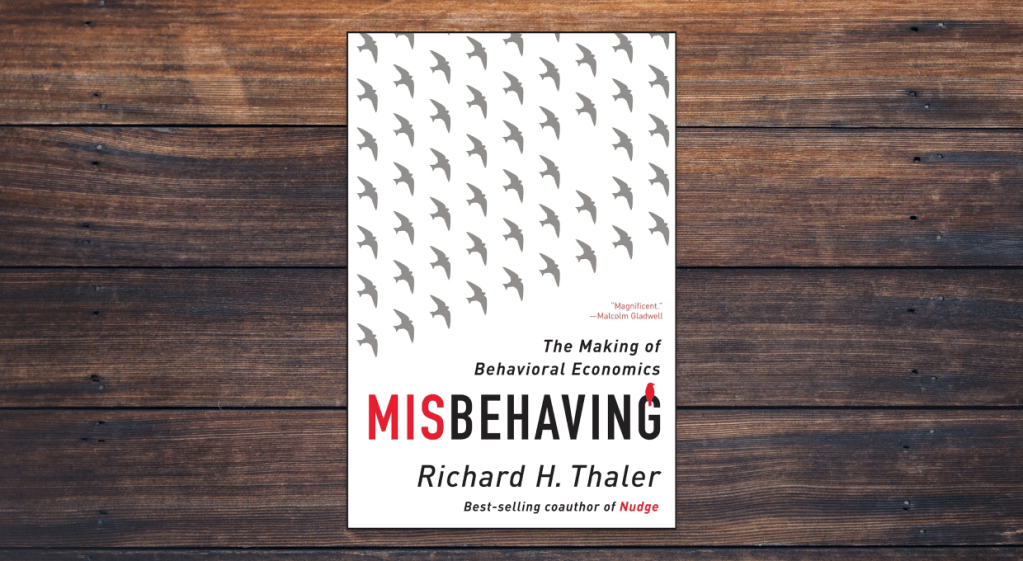
Most personal finance advice assumes you are a rational actor. Save more than you spend. Invest early. Avoid debt. The logic is airtight. So why is it so hard to follow?
Misbehaving: The Making of Behavioral Economics by Richard Thaler argues that the problem isn’t a lack of information. It’s that humans are not the rational, self-interested agents that classical economics assumes we are. We are emotional, distracted, and predictably irrational. Understanding that about yourself is, oddly enough, one of the most practical things you can do for your finances.
Book Summary
Published in 2015, Misbehaving is part memoir, part manifesto for a field that Thaler helped build from the ground up. The book traces the history of behavioral economics, a discipline that blends psychology and economics to explain why people make the financial decisions they actually make rather than the ones they theoretically should.
Thaler walks readers through decades of research, much of it conducted alongside collaborators like Daniel Kahneman and Amos Tversky. He introduces concepts like mental accounting, the endowment effect, and present bias, and shows how each one leads ordinary people to make financial choices that undermine their own goals. The book is accessible, often funny, and grounded in real-world examples ranging from the NFL draft to retirement savings behavior.
Who Is Richard Thaler?
Richard Thaler is a professor of behavioral science and economics at the University of Chicago Booth School of Business. He is widely regarded as one of the founding figures of behavioral economics and won the Nobel Memorial Prize in Economic Sciences in 2017 for his contributions to the field.
Thaler is also co-author, with Cass Sunstein, of Nudge, a book that applies behavioral economics to public policy and became influential in government circles around the world. His academic work spans loss aversion, intertemporal choice, and the psychology of decision-making under uncertainty. He is not a self-help guru or financial advisor. He is a researcher who spent decades trying to convince economists that real human behavior matters.
Key Lessons from the Book
Misbehaving is dense with insight, but a few lessons are particularly relevant to anyone trying to build better money habits.
The first is mental accounting. Thaler demonstrates that people treat money differently depending on where it came from or where it is mentally categorized. A tax refund feels like a windfall and gets spent freely, even though it’s the same money you earned throughout the year. Recognizing this tendency can help you make more deliberate decisions about how you allocate funds rather than letting psychological framing do it for you.
The second is the endowment effect. Once you own something, you value it more than you would if you didn’t own it. This has real implications for investors who hold losing positions too long because selling feels like a loss rather than a correction.
The third is present bias. People consistently overvalue what they can have right now versus what they could have in the future. This is one of the core reasons that saving for retirement is so psychologically difficult even when the math makes it obviously worthwhile. Thaler’s research contributed directly to the design of automatic enrollment in 401(k) plans, which work precisely because they use inertia to overcome present bias rather than fighting it.
The broader lesson is structural: if you design your financial life to account for your psychological weaknesses rather than pretending they don’t exist, you are more likely to succeed. Automating savings, using a high-yield savings account for your emergency fund so you’re at least earning something while the money sits, and setting up automatic investments into an S&P 500 index fund are all practical applications of this thinking. The system does the work so your in-the-moment self can’t undermine your long-term self.
Criticisms of the Book
Misbehaving is not without its weaknesses. The most common criticism is that the book is too long and self-congratulatory in places. Thaler spends considerable time recounting his own battles to get behavioral economics accepted within mainstream academia, and while that history is interesting, it can feel indulgent. Readers looking for a tighter read focused purely on actionable lessons may find the pacing uneven.
Some critics have also pointed out that behavioral economics, despite its insights, can be used paternalistically. Knowing that people are susceptible to nudges is a double-edged tool. Governments and corporations can use the same techniques Thaler champions to steer people toward outcomes that benefit institutions rather than individuals.
Finally, the book is stronger on diagnosis than prescription. Thaler is very good at explaining why people make bad decisions. He is less focused on giving readers a step-by-step framework for changing their behavior. Readers expecting a personal finance manual will need to do some of that work themselves.
Should You Buy This Book?
Yes, particularly if you have ever wondered why you know what you should do with your money but struggle to do it. Misbehaving gives you a vocabulary and a mental model for understanding the gap between intention and action. That understanding is genuinely useful.
It pairs well with other foundational books in the behavioral and personal finance space. If you have read Thinking, Fast and Slow by Daniel Kahneman, Misbehaving is a natural complement. If you haven’t read either, Kahneman’s book may actually be the better starting point, as it covers the psychological foundations in more depth. But Thaler’s book is more personal, more narrative, and more focused on economics specifically.
If you are looking for a book that changes how you think about your own financial decision-making, Misbehaving is worth your time and the cost of the book.
Final Thoughts
The central argument of Misbehaving is simple and important: people are not rational, and pretending otherwise leads to bad policy, bad financial products, and bad personal outcomes. Thaler spent his career making that case within a discipline that initially resisted it, and the Nobel Prize suggests he was right.
For anyone interested in money, budgeting, and learning how psychology shapes financial behavior, this book belongs on the shelf. It won’t give you a budget template or a specific investment strategy. What it gives you is something more durable: a clearer picture of the mind you’re working with every time you make a financial decision.











You must be logged in to post a comment.