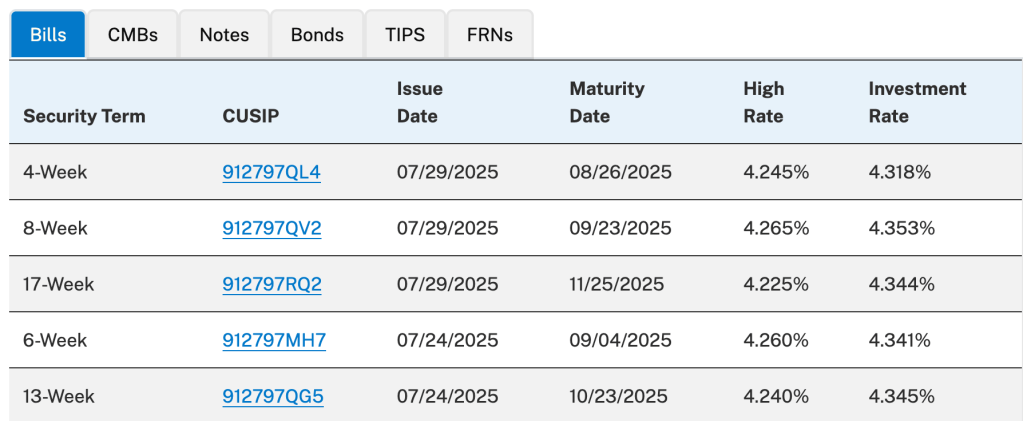
Treasury bills and Treasury notes are both IOUs from the U.S. government, but they serve different jobs in your portfolio. The difference comes down to maturity, and maturity changes everything about how they behave.
Maturities: the core difference
T-bills mature in 4 weeks to 1 year. They’re sold at a discount and pay no periodic interest: you buy at $9,800, get $10,000 at maturity. Treasury notes mature in 2 to 10 years, pay interest every six months (the “coupon”), and are sold at or near face value. If you want the full T-bill mechanics, our guide to buying Treasury bills covers it.
Yield behavior
Longer maturities usually (not always) mean higher yields, since investors demand more to lock up money longer. But longer also means more price volatility: if rates rise, a 10-year note’s market value drops more than a 3-month bill’s. T-bills are cash-like; notes are investments with real interest-rate risk.
The full maturity lineup
T-bills come in 4, 8, 13, 17, 26, and 52-week maturities. Treasury notes come in 2, 3, 5, 7, and 10-year maturities. Beyond notes sit Treasury bonds (20 and 30 years), which work like notes with even longer horizons and even more price volatility. The pattern is consistent: shorter means more cash-like and flexible, longer means higher typical yield but bigger price swings when rates move.
Price risk: a worked example
Buy a $10,000 10-year Treasury note paying 4%. If market rates rise by one percentage point, the note’s market value drops roughly 8%, or about $800 on paper, because new buyers demand the higher yield. A 3-month T-bill in the same scenario barely budges, losing only about 0.25%. That’s the trade: the note locks in 4% for a decade, but if you need to sell early after rates rise, you’ll take a haircut. T-bills held to maturity have no price risk at all.

When each fits
Parking cash you might need soon? T-bills. Building a bond ladder or locking in yields for years? Treasury notes. In a high-rate environment, some investors prefer staying short (T-bills) to stay flexible; others lock in notes to guarantee the yield. (If bank rates confuse you, our high-rate vs. investment-rate explainer helps decode what “high yield” means.)
Taxes
Both are exempt from state/local tax, taxed federally as ordinary income. Notes’ coupon payments are taxed in the year received; T-bill discount is taxed at maturity.
Building a Treasury ladder
You don’t have to choose one or the other. A ladder mixes maturities: for example, put a third of your fixed-income money in 3-month T-bills (flexibility), a third in 2-year notes (a yield pickup), and a third in 5-year notes (locking in rates). As each rung matures, reinvest at the longest rung. You get regular access to cash, rising-rate protection on the short end, and yield locked in on the long end. It’s the same laddering concept as with CDs, applied to Treasuries.
Three mistakes with Treasuries
First, selling a Treasury note after rates rise and locking in a loss that patience would have erased. If you hold to maturity, you get the full face value regardless of market swings. Second, ignoring the state-tax exemption. In a high-tax state, a Treasury yielding 4.3% can beat a corporate bond yielding 4.6% after state taxes. Third, reaching for yield by going long without a plan. A 10-year note is not a cash substitute; if you might need the money in two years, the price risk isn’t worth the extra yield. Match the maturity to the job.











You must be logged in to post a comment.