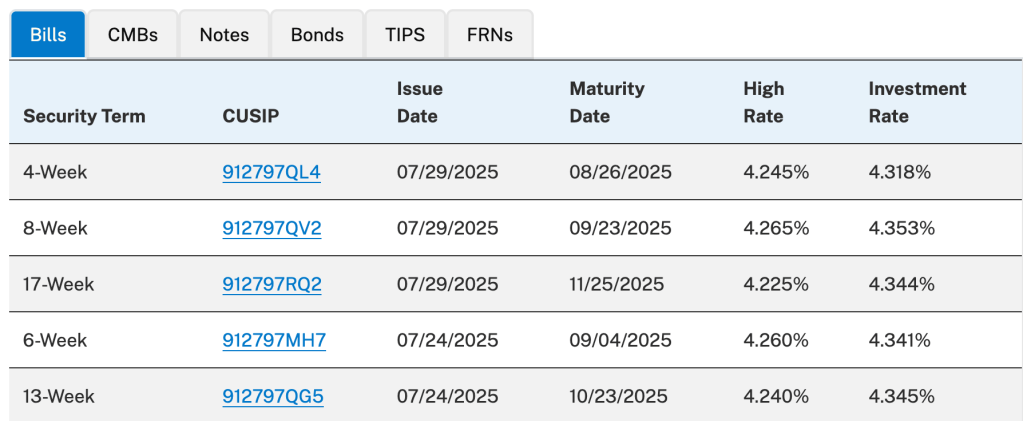
Treasury bills are already tax-efficient, but holding them inside a Roth IRA makes their interest completely tax-free. Here’s how to buy T-bills in your Roth through a brokerage, and when it makes sense.
Why hold T-bills in a Roth IRA?
T-bills are exempt from state and local tax, but you still owe federal tax on the interest. Inside a Roth IRA, qualified withdrawals are federal-tax-free too, so T-bill interest becomes truly tax-free. It’s a clean way to park cash inside a retirement account without taking market risk.
How to buy them through a brokerage
You can’t buy T-bills at TreasuryDirect inside a Roth, since TreasuryDirect doesn’t offer IRAs. Instead, buy through your broker (Fidelity, Schwab, Vanguard all offer new-issue T-bills with no markup). Place the order inside your Roth IRA account, just as you would in a taxable account. Our guide to buying Treasury bills covers the mechanics; the only difference is the account you buy in.
Step by step: buying a T-bill in your Roth
Log in to your brokerage and make sure you’re in the Roth IRA account, not the taxable one. Navigate to the fixed-income or bonds section and look for new-issue Treasuries or Treasury auction. Pick a maturity (13-week and 26-week bills are the most popular), enter the amount, and submit the order. Many brokers offer auto-roll, which automatically buys a new bill when yours matures. Set a calendar reminder for the maturity date so the cash doesn’t sit idle afterward.
Roth IRA contribution limits for 2026
You can contribute up to $7,000 to a Roth IRA for 2026 ($8,000 if you’re 50 or older), as long as you have at least that much earned income. High earners phase out: the ability to contribute directly shrinks above certain income thresholds, though the backdoor Roth remains an option. Remember that buying T-bills doesn’t create contribution room; the cash has to be contributed to the Roth first, then used to buy bills inside the account.

The tax angle
In a taxable account, T-bill interest is federally taxable. In a Roth, it’s not, ever, as long as you follow the qualified-distribution rules. That said, don’t overthink it: if you’re in a high-tax state, T-bills in taxable are already efficient. The Roth is best for money you want both safe and permanently sheltered.
When T-bills in a Roth don’t make sense
The opportunity cost is real. Money sitting in T-bills inside a Roth isn’t in stocks, and over decades the stock market has returned far more. If your Roth is meant for retirement 20+ years away, a heavy T-bill allocation is likely too conservative. T-bills in a Roth make sense for cash you need stable: a house down payment fund, money you’ll need within a few years, or the conservative sleeve of an otherwise stock-heavy retirement portfolio. Don’t park your entire Roth in T-bills by default.
T-bills vs. money market funds in a Roth
Most brokerages offer a money market sweep fund as the default cash position in a Roth IRA, and for many people that’s fine. T-bills usually yield a bit more than money market funds, and the state-tax exemption doesn’t matter inside a Roth anyway. The trade-off is effort: money market funds are automatic, while T-bills require placing orders and managing maturities. If the yield gap is small (under 0.25%), the simplicity of the money market fund wins. If it’s larger, T-bills are worth the few minutes.
Who this suits
This works for anyone holding cash inside a Roth: emergency-fund overflow, money waiting to be invested, or a conservative sleeve of a retirement portfolio. Just remember: T-bills yield less than stocks over time, so don’t park long-term retirement money here. For the yield math, see our high-rate vs. investment-rate explainer.











You must be logged in to post a comment.