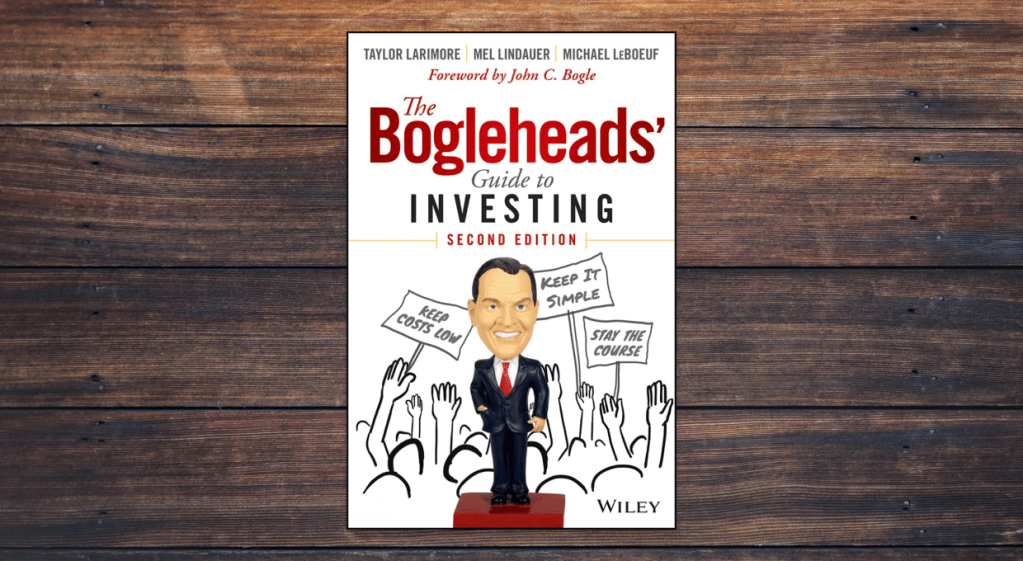
Some books teach you how to pick stocks. The Bogleheads’ Guide to Investing teaches you something more valuable: how to stop trying. Written by three disciples of Vanguard founder John C. Bogle, it is the closest thing investing has to an instruction manual — plain-spoken, practical, and allergic to Wall Street salesmanship.
Book Summary
First published in 2006 and updated in a second edition in 2014, The Bogleheads’ Guide to Investing grew out of the Bogleheads.org forum, an online community of investors who follow the philosophy of John C. Bogle, the founder of Vanguard and creator of the first index fund for individual investors.
The book’s argument is disarmingly simple. Most investors would do better if they saved diligently, bought low-cost index funds, allocated sensibly between stocks and bonds, minimized taxes, and then left the portfolio alone. The authors walk through each piece in short, jargon-free chapters: how much to save and where to put it, how 401(k)s and IRAs work, how to choose an asset allocation that matches your age and temperament, why costs are the most reliable predictor of fund performance, and how to write an investment policy statement so you stay disciplined when markets get frightening.
It also covers the unglamorous machinery of a financial life that most investing books skip: emergency funds, insurance, estate planning, and how to handle windfalls. The tone throughout is that of a knowledgeable friend who has no products to sell — because the authors genuinely don’t.
Who Are Taylor Larimore, Mel Lindauer, and Michael LeBoeuf?
The three authors are longtime leaders of the Bogleheads community rather than professional money managers, which is precisely the point. Taylor Larimore — dubbed “the King of the Bogleheads” by Bogle himself — was one of the original Vanguard Diehards on the Morningstar forums in the late 1990s. Mel Lindauer, “the Prince of the Bogleheads,” spent decades as a Forbes.com columnist writing about personal finance. Michael LeBoeuf is a business professor and bestselling author who brought a writer’s polish to the project. John C. Bogle wrote the foreword, lending the book his personal stamp of approval.
Lessons From The Bogleheads’ Guide to Investing
Costs are the one thing you can control. The book hammers the arithmetic that active fund managers hope you never do: a fund charging 1% a year versus an index fund charging 0.05% hands the expensive fund a permanent headwind. Over decades, that gap compounds into an enormous share of your wealth. Cost is the best predictor of a fund’s future relative performance.
Start saving early and automate it. The first chapters argue that your savings rate matters far more than your investment returns, especially in the early years. Automating contributions to retirement accounts removes willpower from the equation.
Own the whole market and hold it. Broad index funds give you diversification no stock picker can match, at a fraction of the price. The book’s evidence review shows that the vast majority of professional managers underperform simple index portfolios over long periods.
Match your asset allocation to your life, not the headlines. The authors give concrete frameworks for deciding how much to hold in stocks versus bonds based on age, job stability, and how you actually behaved in the last crash — not how you imagine you’d behave.
Put taxes and account types to work. The Bogleheads’ Guide to Investing explains which assets belong in tax-advantaged accounts like 401(k)s and IRAs versus taxable accounts, how to use Roth conversions and backdoor Roth IRAs, and why tax-loss harvesting matters. These are the details that quietly add percentage points to real-world returns.
Write an investment policy statement and rebalance. Committing your plan to paper — what you’ll own, why, and what you’ll do in a crash — is the authors’ antidote to panic selling. Periodic rebalancing keeps the plan on track.
Criticisms of the Book
The second edition dates to 2014, so some specifics are stale: contribution limits, tax brackets, and estate-tax thresholds have all moved since. The principles survive, but readers should verify current numbers rather than treating the book as a tax reference.
The advice is unapologetically American — 401(k)s, IRAs, and Social Security feature throughout — so international readers will need to translate the account types to their own systems. Experienced investors may also find the treatment light; the book deliberately trades depth for accessibility, and it won’t satisfy anyone looking for advanced portfolio theory.
Finally, the Boglehead philosophy is index-fund absolutism, and reasonable people disagree at the margins. Investors who want to tilt toward small-cap value, hold individual stocks as a hobby, or explore alternatives won’t find much encouragement here. The book’s answer to “but what about beating the market?” is essentially: you almost certainly won’t, so don’t pay for the attempt.
Who is This Book For?
The Bogleheads’ Guide to Investing is written for the person who suspects their 401(k) is a mess, their advisor is expensive, or their stock-picking hobby is losing to a savings account. It assumes no financial knowledge and builds from first principles, which makes it one of the best first investing books you can hand someone. It is also genuinely useful for intermediate investors who want to sanity-check their asset location, insurance coverage, and estate plan against a trusted checklist.
It is not for thrill-seekers, professional investors, or anyone hoping to learn security analysis. If you want to pick stocks, this book will try — politely, with data — to talk you out of it.
Final Thoughts
There are more entertaining investing books and more sophisticated ones, but few more useful. The Bogleheads’ Guide to Investing takes everything John Bogle spent a career proving — that costs matter, that simplicity wins, that discipline beats cleverness — and turns it into a manual you can actually follow. A decade after its second edition, its core message is only more true: the less you pay Wall Street and the less you fiddle, the more of the market’s returns you keep.











You must be logged in to post a comment.