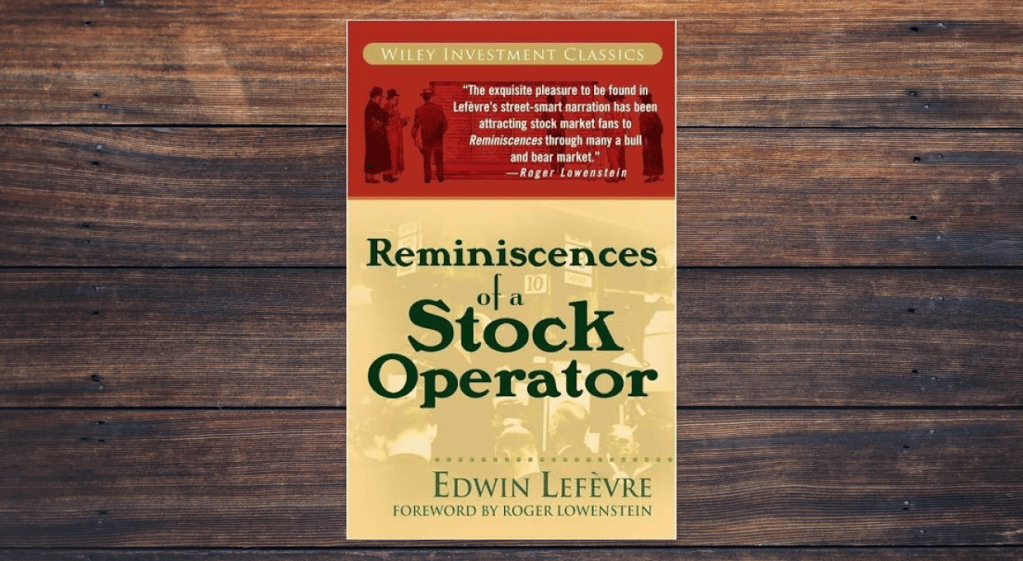
Every few years, a new generation of investors rediscovers Reminiscences of a Stock Operator and is startled to find that a book published in 1923 reads like it was written about last week’s market. Written by financial journalist Edwin Lefevre, it is the fictionalized biography of Jesse Livermore, the legendary speculator who made and lost several fortunes trading stocks and commodities in the early 1900s. In the book, Livermore appears as “Larry Livingston,” but the tape-reading wisdom, the spectacular blowups, and the hard-won rules about cutting losses are all his. More than a century later, it remains the most honest book ever written about what it actually feels like to speculate.
Book Summary
Reminiscences of a Stock Operator follows Larry Livingston from his start as a teenage quotation-board boy in a Boston bucket shop, a kind of betting parlor where customers wagered on stock price movements without owning shares, to his rise as one of the most feared operators on Wall Street. Along the way he wins fortunes by reading the tape, loses them by breaking his own rules, and slowly assembles a philosophy of speculation that reads like a confession. The narrative arc is a cycle every trader will recognize: discipline brings success, success breeds overconfidence, overconfidence brings ruin, and ruin teaches discipline again.
The book is structured as a series of episodes from Livingston’s career, the bucket-shop days, the great bull markets, the short sales during panics, the periods of sitting out entirely, each one delivering a lesson he paid dearly to learn. What makes Reminiscences of a Stock Operator unusual among finance books is that it is really a book about human nature wearing a stock market costume. The tickers change and the quotes arrive on a phone instead of a chalkboard, but the emotions driving every trade, hope, fear, greed, and the desperate need to be right, have not changed at all.
Who is Edwin Lefevre?
Edwin Lefevre was a journalist who covered Wall Street for decades and knew its operators personally. He wrote for the financial press at a time when the Street was still a small, rough-edged world, and he had the rare ability to turn traders’ street talk into literature. Reminiscences of a Stock Operator is his masterpiece, a first-person narrative so convincing that many readers have assumed Livermore wrote it himself. He didn’t; Lefevre conducted long interviews with Livermore and shaped the material into the voice of “Larry Livingston,” a fictional name that let both men tell the truth without quite telling it.
The man behind the fiction, Jesse Livermore, was one of the most remarkable speculators who ever lived. Starting with nothing as a teenager, he built fortunes large enough to move markets, went bankrupt multiple times, and each time clawed his way back. His life ended tragically in 1940, which gives the book’s lessons about risk a somber undertone: the man who understood speculation better than anyone still could not always survive it.
Lessons From Reminiscences of a Stock Operator
The first and most repeated lesson of Reminiscences of a Stock Operator is to cut losses quickly and let winners run. Livingston learns, at enormous cost, that the average speculator does the exact opposite: taking small quick profits because it feels good, while letting losers grow because admitting the mistake hurts. Livermore’s rule is mechanical precisely because the psychology is so hard. Decide in advance where you are wrong, and get out there.
Second, the big money is made in the sitting, not the thinking. Livermore’s most quoted line in the book is that it was never his thinking that made the big money for him, it was his sitting tight. He waited, sometimes for months, until the market confirmed his judgment, and then he committed fully. Most traders fail from impatience: they need action, so they trade, and the commissions and whipsaws eat them alive. The book argues that knowing when to do nothing is the hardest and most profitable skill in speculation.
Third, never listen to tips, and never trade on someone else’s opinion. Every one of Livingston’s worst losses in the book begins with him abandoning his own read of the market to follow a friend’s hot tip or a broker’s urging. The tip itself is not the problem; the problem is that borrowed conviction evaporates the moment the trade goes against you, because you never understood the reasoning in the first place. If you cannot explain why you are in a trade, you should not be in it.
Fourth, human nature never changes, so the patterns repeat. Livermore argues that fear and greed drive every market the same way they drove the ones he traded, which means the careful student of past panics and manias has a genuine edge. This is the intellectual ancestor of everything behavioral finance later formalized: the market is a machine for transferring money from the impatient and emotional to the patient and disciplined.
Fifth, trade the market you have, not the one you want. Livingston’s breakthrough as a trader comes when he stops arguing with the tape and starts listening to it. Prices are facts; opinions about where prices should go are wishes. The book’s repeated refrain, don’t fight the tape, is a warning against letting your analysis override what the market is actually doing. When your thesis and the price disagree, the price is right until proven otherwise.
Criticisms of the Book
The fairest criticism of Reminiscences of a Stock Operator is that it is a memoir of a speculator, not a guide for an investor. Livermore traded aggressively, used leverage, and concentrated heavily; the strategies that made him millions are the same ones that bankrupted him repeatedly. A reader who takes the book as a how-to manual for their retirement account is misreading it badly. It is a book about the psychology of risk, not a blueprint for building wealth.
The world it describes is also gone. Bucket shops, ticker tapes, cornering stocks with a handful of operators, the market structure of 1923 has almost nothing in common with today’s electronic markets. Tape reading as Livermore practiced it does not translate directly to an era of algorithms and index funds. The lessons survive the translation, but the tactics mostly do not, and the book offers no help with the gap.
There is also the uncomfortable fact of Livermore’s ending. The man who wrote, through Lefevre, that speculation’s lessons must be paid for in cash paid for them again and again, and his story does not close with a comfortable retirement. The book never quite resolves the tension between its brilliant insights and the life of the man who had them. Read it as wisdom, not as evidence that the wisdom is sufficient.
Who is This Book For?
Reminiscences of a Stock Operator is for anyone who trades or is tempted to trade, and wants to understand the psychological game before the market charges tuition for the lesson. It is essential reading for active traders, fascinating for students of market history, and surprisingly useful for long-term investors, who will recognize their own impulses, the urge to tinker, the fear of missing out, the pain of holding losers, in Livingston’s confessions. It is not for anyone looking for a system, a screener, or a set of rules to follow; the book offers principles, and principles require judgment.
Final Thoughts
A century after publication, Reminiscences of a Stock Operator remains the best book ever written on the inner game of speculation: cut your losses, sit tight on your winners, ignore tips, and never argue with the tape. Its market is gone and its hero’s ending was tragic, but its subject, human nature under financial pressure, has not changed one bit. Every investor, even the most committed buy-and-hold indexer, should read it once: understanding how speculation goes wrong is one of the cheapest ways to make sure your own plan goes right.











You must be logged in to post a comment.