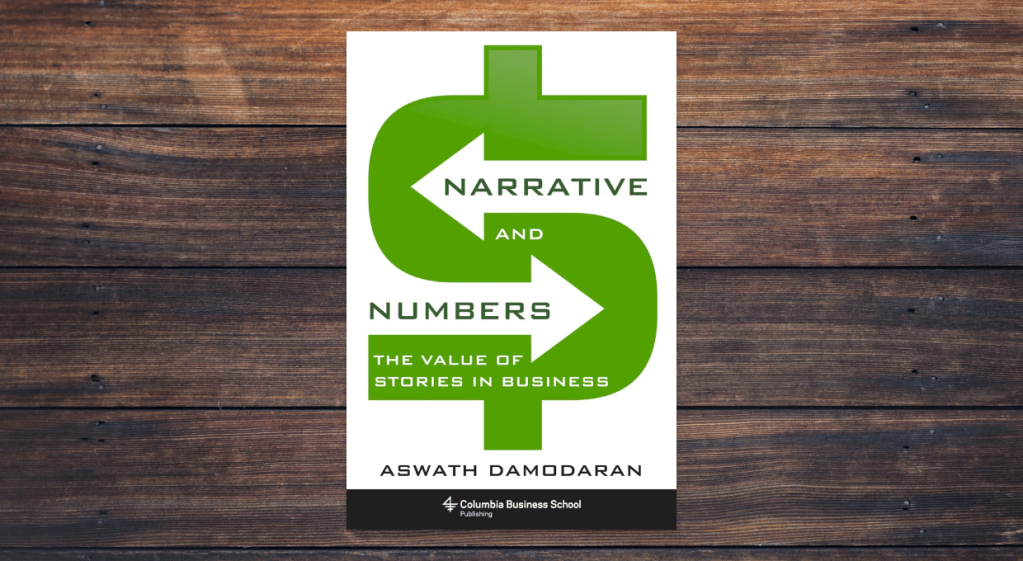
Every valuation you’ve ever seen is two things at once: a story someone is telling, and a spreadsheet pretending the story isn’t there. Narrative and Numbers is Aswath Damodaran’s argument that great investing requires both — and that the investors who get into trouble are the ones who let one side operate without the other.
Book Summary
Published in 2017 by Columbia University Press, Narrative and Numbers: The Value of Stories in Business starts from a simple observation: nobody experiences a business as a discounted cash flow model. People experience companies as explanations — about the product, the customers, the competition, and where it all goes from here. Damodaran’s claim is that valuation is the bridge between that story and the numbers, and that the bridge runs in both directions.
The book is organized as a three-act process. First, craft the business narrative: what problem the company solves, how big the market is, what edge lets it win, and what could go wrong. Second, convert that narrative into value drivers — revenue growth, margins, reinvestment, risk — the inputs every valuation model actually runs on. Third, and most importantly, close the loop: use the numbers to stress-test the story, and use the story to sanity-check the numbers. A narrative that can’t survive conversion into a model is marketing; a model whose implied story makes no sense is fantasy.
Damodaran works the method through real cases: Uber’s debut and the wildly different valuations it attracted, the Twitter and Facebook IPOs and why one stagnated while the other compounded, Apple and Amazon as examples of how a company’s history both enriches and constrains its narrative, and Vale, the Brazilian mining giant, as a lesson in how country, commodity, and currency can hijack a story. Each case shows the same discipline: write the story down first, so the model has something to answer to.
Who is Aswath Damodaran?
Aswath Damodaran is a professor of finance at NYU’s Stern School of Business, where his corporate finance and valuation courses are among the most popular — and most feared — in the program. He is widely known as the “Dean of Valuation,” the author of the standard textbooks Investment Valuation and Damodaran on Valuation, and the blogger behind Musings on Markets, where he publishes his valuation models, datasets, and teaching materials for free. Few people alive have thought harder about what a company is actually worth, and fewer still share their work so openly.
Lessons From Narrative and Numbers
Every number in a valuation is a story in disguise. A revenue growth forecast isn’t a number — it’s a claim about the market, the competition, and the company’s edge. Damodaran’s first discipline is to make the story explicit before touching a spreadsheet, because a hidden story can’t be argued with.
Use numbers to keep the story honest. Stories are seductive, and the same narrative skills that explain a business can be used to sell one. Converting the narrative into drivers — growth, margins, risk — forces the storyteller to confront which parts are improbable. Narrative and Numbers treats the model as a lie detector for the pitch.
Use the story to keep the numbers honest. The reverse failure is just as common: elaborate models whose implied narrative — say, a dying retailer growing revenue 15% a year forever — is nonsense nobody would say out loud. Every model should be translated back into plain English and checked for plausibility.
Keep the narrative small and testable. The best business stories are specific enough to be measured and humble enough to admit what is unknown. Vague superlatives about “disruption” and “optionality” are warning signs; concrete claims about customers, pricing power, and unit economics are the real thing.
Revisit the story when the world changes. Valuations go stale because narratives do. Damodaran’s feedback loop is continuous: new information should update the story first, and the model follows. An investor who updates numbers without re-examining the story is just repainting a cracked foundation.
Criticisms of the Book
The book is stronger on narrative than on numbers. Readers hoping for a hands-on guide to building discounted cash flow models will find the mechanics sketched rather than taught — Damodaran points to his textbooks and free online materials for the heavy lifting, but this book alone won’t make you a modeler.
Some of the marquee case studies have aged. Uber’s debut, Twitter’s stagnation, and Facebook’s rise were written about companies at very specific moments; the stories have since taken sharp turns (Twitter’s sale to Elon Musk being the most dramatic). The method survives the examples, but a few chapters feel like time capsules.
Finally, the approach has an academic’s confidence that discipline alone tames uncertainty. In practice, two investors can write two reasonable narratives about the same company and arrive at wildly different values — the book tells you how to be coherent, not how to be right. Coherence is valuable, but it isn’t a moat.
Who is This Book For?
Narrative and Numbers is for investors who build or read valuation models and suspect the real action is in the assumptions, not the arithmetic. It’s also genuinely useful for founders and executives who pitch investors: understanding how a story converts into value drivers is the difference between a compelling deck and a fundable one. Finance students will find it the most readable on-ramp to Damodaran’s larger body of work.
It is not a beginner’s investing book. If you’ve never seen a discounted cash flow model, start with something more basic and come back to this when you want to understand what the model is actually saying.
Final Thoughts
Most valuation books teach you to crunch harder. Narrative and Numbers teaches you to think first — to write down what you believe about a business in plain sentences, and only then let the spreadsheet hold you to it. That discipline won’t make your forecasts right, but it will make your mistakes visible, which is the more valuable skill. For any investor who has ever hidden behind a model’s false precision, this is the corrective.











You must be logged in to post a comment.