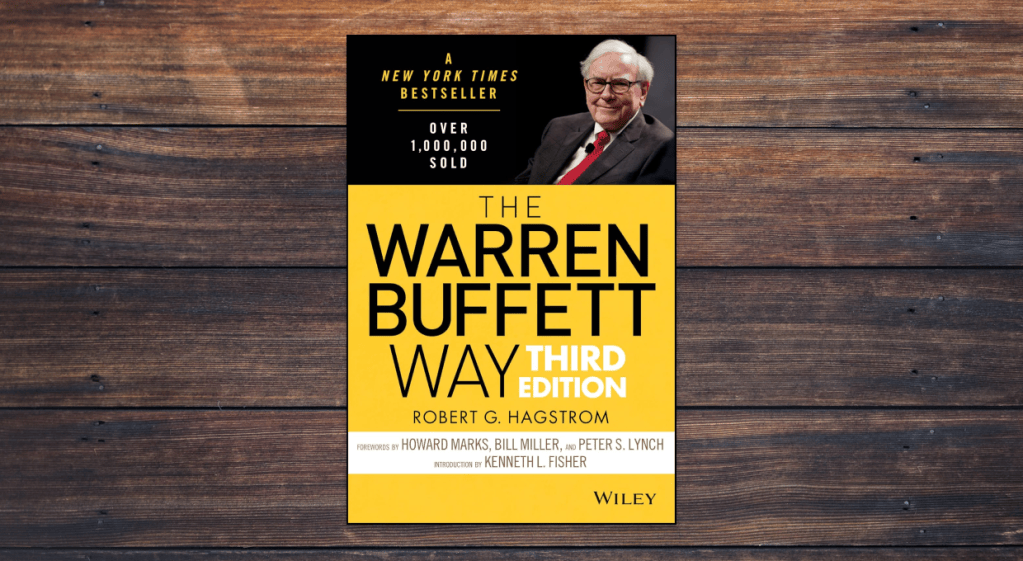
Most books about Warren Buffett are either hero worship or impenetrable theory. The Warren Buffett Way is neither. Robert G. Hagstrom, who has been writing about Buffett’s investing since 1984, set out to do something harder: take apart Buffett’s actual investment decisions and show the method behind them. The result is the clearest breakdown ever written of how Buffett thinks about buying a business.
Book Summary
The Warren Buffett Way studies Buffett’s investments at Berkshire Hathaway and distills them into four groups of tenets: business tenets, management tenets, financial tenets, and value tenets. Instead of vague praise for Buffett’s genius, Hagstrom walks through real purchases, Coca-Cola, The Washington Post, GEICO, and others, and shows which tenets each one satisfied. The structure makes the book unusually actionable: you finish with a checklist you can actually apply to your own stock research.
The business tenets cover the kind of company Buffett wants: simple and understandable businesses with consistent operating history and favorable long-term prospects. The management tenets cover the people: rational, candid, owner-oriented managers who resist the urge to expand for empire’s sake. The financial tenets cover the numbers: high return on equity, strong owner earnings, low debt, and the discipline to retain earnings only when they can be reinvested at high rates. And the value tenets cover the price: determine the business’s intrinsic value, then buy only at a significant discount.
Two ideas do the most work in the book. The first is the economic moat, Buffett’s term for a durable competitive advantage, which Hagstrom frames as the “consumer monopoly”: a business customers come back to because of brand, habit, or switching costs rather than the lowest price. The second is owner orientation, the insistence that the right question is always what an intelligent owner would do with the business, not what the stock price will do next quarter.
Who is Robert G. Hagstrom?
Robert G. Hagstrom is an investment writer and portfolio manager who has been studying and writing about Warren Buffett‘s methods since 1984, longer than almost anyone outside Berkshire Hathaway itself. He has written several books on Buffett and value investing, and his work is known for being analytical rather than anecdotal: he wants the framework, not the folklore. That sensibility is exactly what makes The Warren Buffett Way different from the dozens of Buffett books that followed it.
Lessons From The Warren Buffett Way
The central lesson of The Warren Buffett Way is that Buffett’s edge is not stock picking, it’s business analysis. He doesn’t trade stocks; he buys pieces of businesses he’d be happy to own outright. Every tenet in the book is a question about the business itself: Is it understandable? Is management owner-oriented? Do the economics improve over time? The stock certificate is incidental.
Second, acquire businesses at sensible prices and then do nothing. The value tenets insist on a margin of safety, paying well below intrinsic value, but Hagstrom emphasizes that Buffett’s holding period is the real multiplier. Coca-Cola and GEICO compounded for decades because Buffett sat still while the moats did the work. Patience isn’t a personality trait in this framework; it’s the strategy.
Third, temperament beats intellect. Hagstrom is blunt that the tenets are simple enough for anyone to learn, and that most investors fail them anyway because fear and greed override the checklist. Charlie Munger, Buffett’s partner and the book’s recurring second voice, supplies much of the psychological steel here: invert the problem, avoid stupidity, and let a few great decisions carry a lifetime.
Fourth, stay inside your circle of competence. The business tenets start with “simple and understandable” for a reason: Buffett refuses to buy what he can’t explain. Hagstrom shows this isn’t humility theater; it’s risk control. Every investment outside your understanding is a guess wearing a spreadsheet.
Fifth, price discipline is non-negotiable. A wonderful business at a terrible price is a terrible investment. The book’s case studies repeatedly show Buffett walking away, or waiting years, rather than overpay. The margin of safety isn’t just downside protection; it’s what makes the future returns possible at all.
Criticisms of the Book
The fairest criticism of The Warren Buffett Way is that it was written before Berkshire’s biggest chapter. The framework describes the Buffett of the 1980s and 1990s, buying wonderful businesses at fair prices. It doesn’t cover the later era of elephant-sized acquisitions, the Apple position, or the airline forays that broke some of the book’s own tenets. A new reader should know they’re getting early-to-mid-career Buffett.
A deeper criticism is the one that haunts all Buffett books: the method looks replicable on paper, but Buffett’s advantages, permanent capital, deal flow, reputation, the ability to buy whole companies, are not. The tenets are genuinely useful for picking stocks, but expecting Buffett-like results from them confuses the framework with the franchise.
Finally, the book is drier than its competitors. Hagstrom is an analyst, not a storyteller, and the tenet-by-tenet structure can read like a textbook in stretches. Readers who want narrative color about Buffett’s life will find more of it in the biographies. This book is for people who want the operating manual.
Who is This Book For?
The Warren Buffett Way is for the investor who wants to understand what value investing actually requires, in concrete terms, rather than slogans. It’s ideal as a first serious Buffett book, especially before the biographies, because it gives you the lens through which everything else about Buffett makes sense. It pairs naturally with the site’s broader Warren Buffett coverage, including his author profile at Warren Buffett. It is not for traders, who will find no timing systems here, or for readers who want Buffett the personality rather than Buffett the analyst.
Final Thoughts
Decades after its first edition, The Warren Buffett Way remains the single best explanation of how Buffett actually invests: the tenets, the moats, the owner orientation, the price discipline. It’s less entertaining than the biographies and less complete than a study of his full career, but nothing else distills the method this cleanly. If you’re serious about value investing, this is the book that turns admiration of Buffett into something you can practice.











You must be logged in to post a comment.