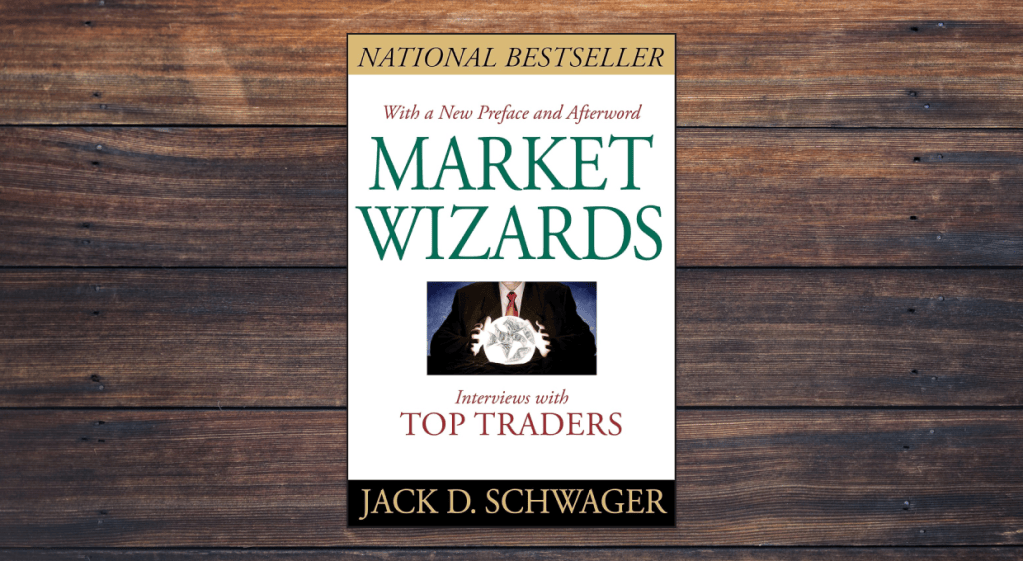
What separates the great traders from everyone else? Jack D. Schwager spent years asking that question directly to the people with the best answer, and Market Wizards is what came back.
Originally published in 1989 and updated in 2012, Market Wizards collects interviews with seventeen of the most successful traders of the era: Bruce Kovner, Richard Dennis, Paul Tudor Jones, Michael Steinhardt, Ed Seykota, Marty Schwartz, Tom Baldwin, and more. It is one of the most recommended books in trading, and even buy-and-hold investors will get their money’s worth from what it teaches about risk, discipline, and market psychology.
Book Summary
Market Wizards has a simple format: Schwager interviews a legendary trader, lets them tell their story in their own words, and then distills each conversation into the principles behind the success. The traders could not be more different from each other. Some are fundamental macro traders, some are pure technicians, some run computerized systems, some trade by feel refined over decades. Kovner is the global macro thinker. Dennis is the trend-following Turtle trader. Seykota is the MIT engineer whose computerized trading earned 250,000 percent over sixteen years. Schwartz is the trader who, after wiping out several times, turned $30,000 into $80 million. Baldwin is the T-bond futures trader who parlayed $25,000 into $2 billion in a single day.
What makes the book work is that Schwager is not looking for a single secret. He lets the contradictions stand: one wizard swears by fundamentals, another by charts, and both made fortunes. The question he keeps circling is what they share beneath the surface. His answer: solid methodology plus the proper mental attitude equals trading success. The method differs. The attitude does not.
Who is Jack D. Schwager?
Jack D. Schwager is a recognized industry expert on futures and hedge funds and the author of a shelf of widely read financial books. He spent over twenty years as a director of futures research for leading Wall Street firms, later became a partner in a London-based hedge fund advisory firm, and has managed futures portfolios himself. In other words, he is not a journalist parachuting into trading from the outside. He speaks the language, which is why the interviews go deeper than the usual “what is your secret” profiles.
Market Wizards launched a whole series of follow-ups. But the original remains the classic, the one traders press into each other’s hands. Nassim Taleb has called it the central document of how real practitioners with skin in the game actually manage their affairs.
Lessons From Market Wizards
Across seventeen interviews, the same handful of lessons keeps surfacing, phrased differently by each trader. These are the ones that stuck with me.
Risk management comes first. This is the closest thing to a unanimous verdict in the book. Every wizard, regardless of style, is obsessed with how much they can lose before they think about how much they can make. Paul Tudor Jones’s rule, that defense is more important than offense, runs through the whole book. Position sizing, stop discipline, and knowing your maximum acceptable loss are not the boring preliminaries to trading. They are the game. For buy-and-hold investors, the translation is straightforward: your position sizes and your willingness to admit a thesis is broken matter more than your stock-picking brilliance.
Cut losses fast and let the method do the work. Nearly every interviewee tells a story about the early loss that taught them everything: the blown-up account, the position they nursed until it nearly killed them. The lesson was never “be smarter.” It was “get out faster.” Marty Schwartz turned $30,000 into $80 million only after learning to take small losses without flinching. Amateurs worry about being right. Professionals worry about what being wrong costs.
A method plus the conviction to follow it. Schwager’s formula is the spine of the book: it is difficult enough to develop a method that works, then it takes experience to believe what your method is telling you, and the toughest task of all is turning analysis into money. An investment process you abandon at the first drawdown is not a process. It is a wish.
Trade in a style that fits your personality. There is no single right way to trade, but there is a right way for you. The systematic traders would be miserable trading discretionarily and vice versa. The wizards succeeded by finding the approach that matched their temperament and refining it for years. For investors, the parallel is style drift: the value investor who chases growth stocks in a bull market, the indexer who starts stock-picking. Know your game and stay in it.
Patience is a position. Again and again, the wizards describe doing nothing as the hardest and most profitable skill: waiting for the right setup, refusing to force trades in dead markets. Kovner and others describe trading as mostly waiting punctuated by brief moments of aggression. Buy-and-hold investors live this lesson by default, but it is worth hearing from people whose entire profession tempts them to overtrade: the money is made in the waiting.
Criticisms of the Book
The honest criticisms of Market Wizards start with survivorship bias, and it is a big one. Schwager interviewed seventeen winners. He did not interview the thousands of traders with similar methods who blew up and disappeared. Every lesson in the book comes with an invisible asterisk: this worked for the people it worked for. The wizards’ confidence in their methods is real, but confidence is cheap among survivors.
Second, the interviews are dated. The original conversations happened in the 1980s, in markets with floor traders, wider spreads, and no high-frequency competition. The 2012 update adds a preface and afterword, but the interviews themselves are time capsules. The psychology holds up. The tactics often do not.
Third, the book is anecdote-heavy with no systematic framework. You get seventeen great stories and a summary of principles, but no data, no base rates, no way to test whether the wizards’ shared traits actually predict success or are just the traits of people who survived. Readers who want evidence rather than stories will find it thin.
Finally, it is a trader’s book. If you are a buy-and-hold index investor, much of the content is about a game you are not playing and should not start playing. The risk-management and psychology lessons transfer. The trading specifics do not, and the book’s excitement can tempt readers into activity that would have been better left alone.
Who is This Book For?
Market Wizards is for active traders first: anyone who trades stocks, futures, or options will find it both entertaining and genuinely instructive. It is also for investors fascinated by market psychology, the question of what separates people who thrive under uncertainty from people who crack. Readers who enjoyed Reminiscences of a Stock Operator, the classic fictionalized memoir of Jesse Livermore, will feel at home here. Same world, different century.
It is also worth reading for buy-and-hold investors who want a deeper feel for risk. You do not have to want to trade to learn from people who think about loss all day. The chapters on position sizing and cutting losers apply to any portfolio with individual stocks in it.
It is not for investors looking for a system to follow. There is no system here, just seventeen of them, and borrowing pieces of each builds something that fits nobody, least of all you.
Final Thoughts
Market Wizards endures because it respects its subject. Schwager does not dumb the traders down or mythologize them. He lets them talk, and what comes out, across every style and market, is a shared professional creed: manage risk first, have a method, believe in it enough to follow it, and be patient. Everything else is commentary.
The survivorship bias is real, and you should read with it in mind. But the book’s value was never “do what these seventeen people did.” It is the slower lesson underneath: success in markets is mostly about what you refuse to do. Refuse unmeasured risk. Refuse to abandon your method. Refuse to trade when there is nothing to do. That is a creed any investor can use.











You must be logged in to post a comment.