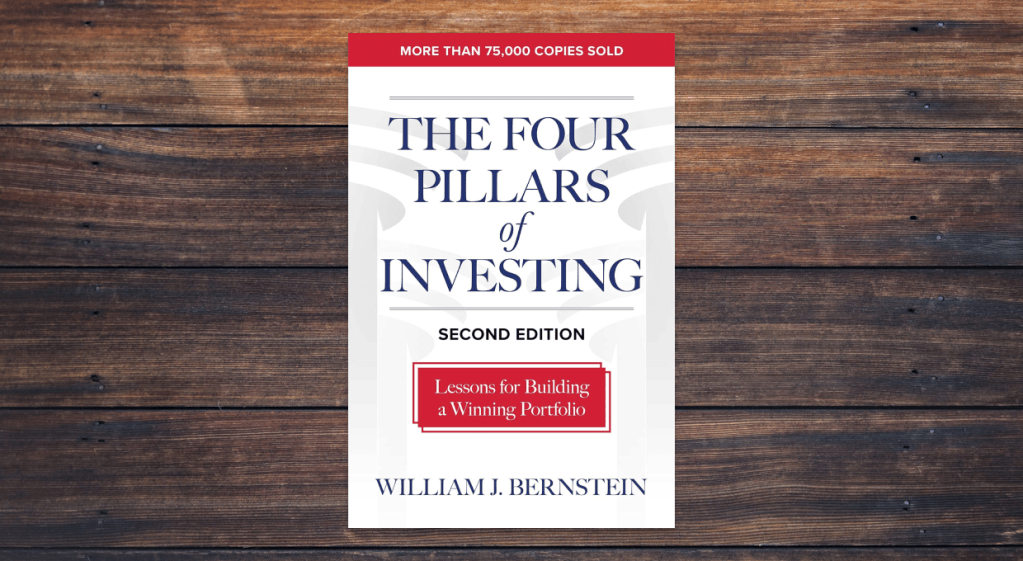
Most investing books hand you a system. The Four Pillars of Investing gives you something rarer: the underlying physics of why systems work or fail. William Bernstein argues that successful investing rests on four pillars — the theory of risk and return, the history of markets, the psychology of the investor, and the business of the investment industry — and that neglecting any one of them will eventually cost you money. First published in 2002, it remains one of the most intellectually honest books ever written for individual investors.
Book Summary
Bernstein structures the book around its four pillars. Pillar one covers the theory: risk and return are inseparable, diversification is the only free lunch, and the market compensates only risks you cannot diversify away. Pillar two is history — centuries of bubbles and crashes, from the South Sea Bubble to the dot-com mania — showing that every mania feels unprecedented and none of them are. Pillar three is psychology: overconfidence, recency bias, and performance-chasing, which Bernstein considers the pillar that matters most. Pillar four is the business of investing: an unsparing look at how the industry’s incentives run directly against the client’s interests, and why costs are the one variable you can actually control. The practical payoff is a simple portfolio of low-cost index funds, rebalanced periodically and held through the noise.
Who is William J. Bernstein?
William J. Bernstein is a former neurologist who left medicine to become one of the clearest translators of academic finance for ordinary investors. He founded the journal Efficient Frontier and wrote The Intelligent Asset Allocator before The Four Pillars of Investing made him a household name among DIY investors. He is also the author of the economic histories The Birth of Plenty and A Splendid Exchange, and of The Investor’s Manifesto, a shorter post-2008 update of the Four Pillars ideas. His hallmark is refusing to dumb things down while staying readable: he trusts the reader with real theory.
Lessons From The Four Pillars of Investing
Risk and return are joined at the hip. You cannot earn stock-market returns without enduring stock-market risk, and the market only compensates risks you cannot diversify away. Bernstein’s punchline: most investors take more risk than they need to reach their goals. Figure out the return you actually require, then take the minimum risk necessary to get it.
Diversification is the only free lunch. Spreading money across stocks, bonds, and domestic and foreign markets is the one reliable way to improve risk-adjusted returns. Bernstein was early and emphatic on owning foreign stocks and the whole market rather than betting on individual winners.
Costs compound against you. Pillar four is Bernstein at his most cynical and most useful: the investment industry’s real product is fees, and every dollar of fees compounds against you for decades. It is the same argument Jack Bogle made in Common Sense on Mutual Funds, delivered with a neurologist’s bluntness.
History doesn’t repeat, but investors always forget. Every bubble feels unprecedented — the details change, the human behavior doesn’t. Bernstein’s tour through centuries of manias is meant to inoculate you: the next one will feel just as much like “this time is different,” and it won’t be.
Your brain is the biggest risk in your portfolio. Overconfidence, recency bias, and the urge to chase whatever just went up will do more damage to your returns than any bear market. The enemy of the investor, Bernstein argues, is the person in the mirror.
The industry is not your friend. Brokers, active fund managers, and financial media all get paid whether you succeed or not. Bernstein’s advice: assume every piece of financial advice you receive is shaped by the advisor’s incentives until proven otherwise.
Rebalance and stay the course. The practical payoff of The Four Pillars of Investing is unsexy on purpose: a simple portfolio of low-cost index funds, rebalanced periodically, held through the noise. Unsexy is the point.
Criticisms of the Book
The obvious criticism is age. Published in 2002, the book’s market examples stop before the 2008 financial crisis, and some of its bond-market discussion predates the zero-interest-rate era. Bernstein partly addressed this in The Investor’s Manifesto (2009), but the original text is what most people buy. Second, the book’s efficient-market leanings mean it gives short shrift to debates it doesn’t find convincing — readers sympathetic to factor investing or valuation-based tilts may find it dismissive. Third, for all its clarity, it is denser than the modern competition: someone choosing between this and The Simple Path to Wealth will find JL Collins an easier first read. The Four Pillars of Investing is the second book, not the first.
Who is This Book For?
DIY investors who want to understand why index investing works, not just be told that it does. If you have read The Simple Path to Wealth or A Random Walk Down Wall Street and want the deeper mechanics — the theory, the history, the psychology — this is the next step. It is also the right book for anyone paying an advisor 1% a year without knowing what they are getting for it; pillar four alone might pay for the book a thousand times over.
Final Thoughts
The Four Pillars of Investing is the rare investing book that respects your intelligence without assuming your expertise. Two decades on, its core argument — that theory, history, psychology, and skepticism of the industry are all non-negotiable — has only aged well. Read it after you have started investing, when you are ready to understand what you are doing and why.











You must be logged in to post a comment.