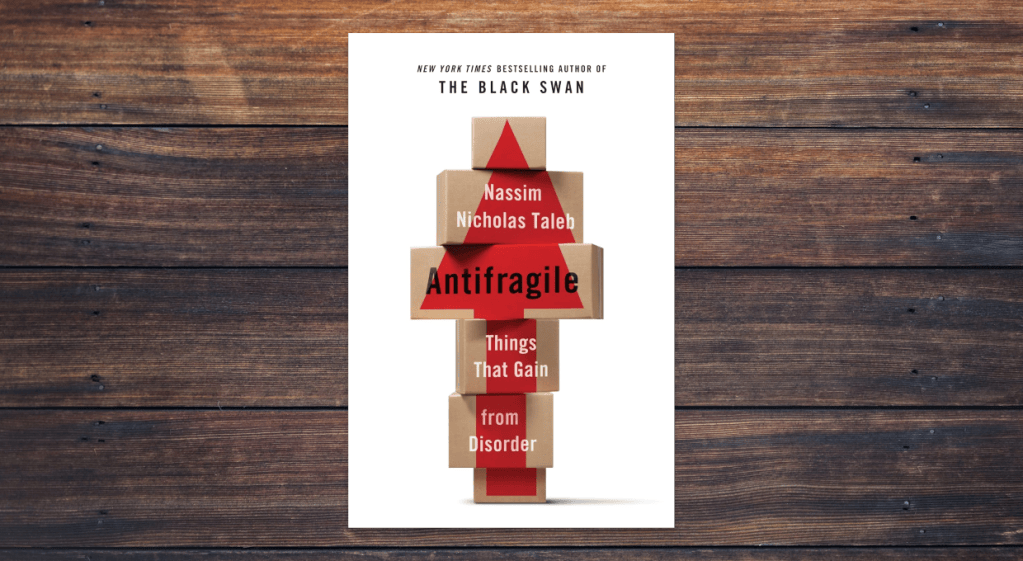
Book Summary
Antifragile is Nassim Nicholas Taleb’s 2012 follow-up to The Black Swan, and it answers the question the earlier book left hanging: if extreme, unpredictable events drive the world, what should you actually do about it? Taleb’s answer is the triad at the heart of the book. Some things are fragile — they break under stress and volatility. Some are robust — they resist shocks and stay the same. And some are antifragile — they gain from disorder. Muscles grow stronger under load, the immune system learns from exposure, and evolution itself feeds on random mutation. The antifragile doesn’t merely survive chaos; it needs it.
The book is a long meditation on how to build antifragility into your life, your portfolio, and your institutions. Taleb argues for the barbell strategy — extreme caution in some areas combined with extreme risk-taking in others, and nothing in the mushy middle. He argues for optionality: arranging your affairs so you have unlimited upside with strictly limited downside, like holding a free call option on the future. He argues for via negativa — improvement by subtraction rather than addition, since removing the harmful is more reliable than adding the beneficial. And he wages war on naive interventionism: the meddling by experts, regulators, and forecasters that makes systems more fragile while claiming to make them safer. The chapter on medicine, where he shows how much medical harm comes from intervention itself (iatrogenics), is one of the book’s most convincing passages.
Later sections cover the Lindy effect (things that have survived a long time will probably keep surviving), domain dependence (our failure to transfer knowledge across fields), and an ethics of risk-taking: those who take risks should have skin in the exposure, and those who don’t bear the downside shouldn’t be making the decisions. Antifragile is sprawling, repetitive, and combative — and it contains some of the most useful ideas about risk published in the last twenty years.
Who is Nassim Nicholas Taleb?
Nassim Nicholas Taleb is a Lebanese-American writer, mathematical statistician, and former options trader. Born in Amioun, Lebanon in 1960, he spent two decades on Wall Street trading derivatives before turning to writing and research on probability, uncertainty, and risk. His Incerto series — Fooled by Randomness (2001), The Black Swan (2007), The Bed of Procrustes (2010), Antifragile (2012), and Skin in the Game (2018) — made him one of the most widely read thinkers on uncertainty in the world.
Taleb’s perspective is shaped by his trading years: he is obsessed with what you don’t know, hostile to prediction, and convinced that the economics and finance professions are built on mathematical tools that don’t survive contact with the real world. His readers on this site will know him from The Black Swan and Fooled by Randomness; Antifragile is where he turns from diagnosis to prescription.
Lessons From Antifragile
1. Seek convexity, avoid concavity. The master concept of Antifragile is that your exposure to uncertainty should be convex — limited downside, open-ended upside. A lottery ticket with a capped cost and a huge potential payoff is convex; a highly leveraged bet where a small move against you wipes you out is concave. Investors should structure their portfolios so that volatility helps them more than it hurts them. Taleb’s barbell is the practical version: keep most of your capital extremely safe, and use a small slice for high-risk bets with explosive upside. No fragile middle.
2. Optionality is the real wealth. An option lets you benefit from the upside of uncertainty without paying for the downside. Taleb argues that much of success — in careers, investing, and business — comes not from planning but from collecting cheap options and letting positive surprises do the work. The investor’s version: small positions in many asymmetric opportunities, no single bet that can ruin you, and the patience to wait for the payoff.
3. Via negativa: subtract, don’t add. We are bad at knowing what to add to a system, but good at knowing what to remove. For investors, this means the first job is eliminating fragility — leverage, concentration, dependence on forecasts, strategies that blow up in a crisis — before chasing returns. Antifragile argues that avoiding stupidity beats seeking brilliance, a claim value investors will recognize immediately.
4. Don’t forecast; position. The Black Swan established that we can’t predict rare, high-impact events. Antifragile supplies the corollary: stop trying. Instead, arrange your life so that you benefit from disorder regardless of which particular shock arrives. For an investor, that means robust cash reserves, no margin, and a portfolio that gains from volatility rather than one that requires calm markets to work.
5. Small is antifragile; big is fragile. Large, centralized systems — big banks, big governments, big corporations — accumulate hidden fragilities and fail catastrophically. Small units fail cheaply and often, which is how they learn. Taleb’s preference for decentralization maps neatly onto the investor’s preference for simple, understandable businesses over sprawling conglomerates.
6. Beware the interventionists. Much of the book attacks the class Taleb calls fragilistas: academics, regulators, and experts whose interventions make systems worse. The investing parallel is the pundit class — forecasters, strategists, and commentators whose confident predictions add noise while pretending to add signal. Antifragile is a long argument for ignoring them.
Criticisms of the Book
Antifragile is not an easy read, and its flaws are real. The book is repetitive — the triad gets restated in dozens of variations across 500 pages, and a sharper editor could have cut a third of it. Taleb’s tone is relentlessly combative; his contempt for economists, Nobel laureates, and academics is entertaining at first and wearying by the end, and it sometimes substitutes insult for argument.
Some ideas are stretched thinner than they deserve. The Lindy effect is fascinating but applied too broadly, and the leap from “muscles grow under stress” to sweeping claims about politics, medicine, and urban planning doesn’t always hold. The final section on ethics reads like a separate, angrier essay bolted onto the book. And for all its praise of risk-taking, Taleb’s own barbell — a secure academic and writing income paired with speculative bets — is a luxury most readers can’t replicate.
None of this undoes the core insights. But readers expecting the tight, story-driven readability of The Black Swan should know that Antifragile is denser, longer, and more polemical. It rewards the patient and punishes the skimmer.
Who is This Book For?
Antifragile is for investors who want a philosophy of risk rather than another stock-picking manual. If you read The Black Swan or Fooled by Randomness and wanted the practical half of the argument, this is that book. It’s for contrarians, systems thinkers, and anyone who suspects that the experts’ confident forecasts are mostly theater.
It’s not for readers who want step-by-step instructions, and it’s not for anyone allergic to polemic. Taleb does not meet you halfway — he assumes you’re willing to work through long philosophical detours to get to the payoff. If you prefer your investing wisdom in short chapters and bullet points, start with Fooled by Randomness instead; it’s the gentlest entry point to his work.
Final Thoughts
Antifragile earns its place on the shelf next to The Black Swan. Its central idea — that you should arrange your affairs to gain from disorder rather than merely survive it — is one of the most important concepts an investor can internalize, and it reframes everything from position sizing to career design. The barbell, optionality, and via negativa are tools I think about regularly.
Yes, it’s bloated. Yes, Taleb is insufferable in places. But the books that change how you think are rarely the tidy ones, and Antifragile changed how I think about risk. Four and a half stars — docked half a star for the bloat, kept high because the ideas are that good.











You must be logged in to post a comment.