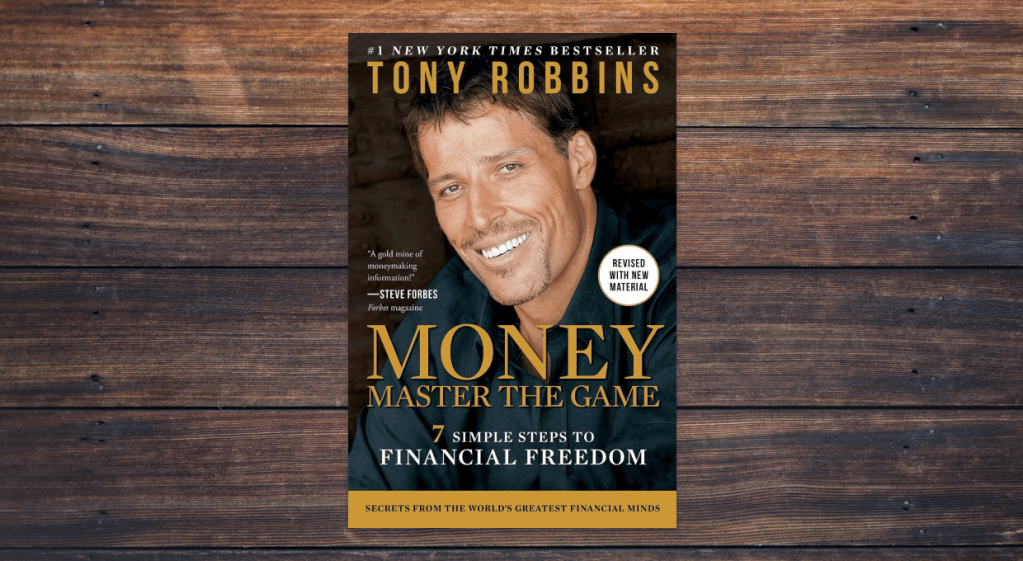
Tony Robbins is the world’s most famous life coach, not a credentialed investor — and that tension is exactly what makes Money: Master the Game such an interesting book. Released in 2014 after four years of research and interviews with more than fifty of the world’s top investors, it became an instant New York Times bestseller and has stayed in print ever since. At nearly 700 pages, it is less a tight investing manual than a sprawling, motivational crash course in how money actually works — with some genuinely valuable material buried inside the bloat.
Book Summary
Money: Master the Game is organized as seven sections, or “7 Simple Steps to Financial Freedom.” Robbins starts with the uncomfortable math: most people save almost nothing and pay hidden fees that quietly eat their returns. From there he moves through the rules of the investing game (fees, 401(k) myths, the compounding of costs), asset allocation (including the famous “All Seasons” portfolio chapter built on principles from Ray Dalio), the billionaire investor interviews, and finally the psychology of wealth — gratitude, contribution, and the mindset shifts that make the money part stick. The through-line is simple: save a meaningful percentage of your income, automate it, keep fees near zero, allocate across asset classes, and don’t try to outsmart the market by picking stocks or timing entries and exits.
Who is Tony Robbins?
Tony Robbins is a motivational speaker, author, and businessman who has coached presidents, professional athletes, and Fortune 500 CEOs for four decades. His seminars — Unleash the Power Within, Date with Destiny — fill arenas. He is not a fund manager, an economist, or a fiduciary advisor, and he has never claimed to be one. What he is: a relentless researcher and interviewer who spent four years getting access to investors most writers could never reach — Warren Buffett, John Bogle, Ray Dalio, Paul Tudor Jones, Carl Icahn — and distilling their thinking for a beginner audience. Robbins later co-authored a tighter follow-up, Unshakeable (2017), for readers who wanted the core financial content without the 700-page commitment.
Lessons From Money: Master the Game
Fees are the silent killer. The most valuable chapter in the book is Robbins’ walkthrough of how 1–2% in annual 401(k) fees compounds into hundreds of thousands of dollars lost over a career. He names names and shows the math. It is the same lesson Jack Bogle preached for fifty years, delivered with Robbins’ salesmanship — and for a beginner, it lands.
Asset allocation beats stock picking. Robbins popularized Ray Dalio’s “All Seasons” portfolio — roughly 30% stocks, 40% long-term bonds, 15% intermediate-term bonds, 7.5% gold, and 7.5% commodities — a mix designed to perform in any economic season. Whether or not you adopt the exact mix, the lesson stands: deciding your allocation across asset classes matters far more than picking individual winners.
The bucket system. Robbins divides savings into buckets: a Security bucket (the foundation — enough to cover the basics, in safer assets), a Risk/Growth bucket (for asymmetric upside), and a Dream bucket (money set aside for the life you actually want). It is mental accounting, but it works for beginners who freeze up at abstract allocation percentages.
Seek asymmetric risk. From his billionaire interviews, Robbins extracts a shared principle: the best investors obsess over downside protection and only take risks where the upside dwarfs the downside. “Don’t lose” comes before “win big” — a very Buffett idea in Robbins packaging.
Automate everything. The recurring command of Money: Master the Game is to take willpower out of the equation: automatic savings, automatic investing, automatic rebalancing. Discipline delegated to systems beats discipline left to mood.
Criticisms of the Book
First, the length. This is a 300-page book wearing a 700-page costume — anecdotes, repetitions, and motivational filler could be cut by half without losing a single investing lesson. Second, the self-promotion. Robbins steers readers toward his own ecosystem — his seminars, his coaching, and (in the original edition) a partnership with Stronghold Wealth Management that drew sharp criticism from fiduciary advocates. The annuity-friendly passages deserve particular skepticism; Robbins has acknowledged his financial interests there, but a beginner won’t necessarily read it that way. Third, the All Seasons portfolio, while educational, is not the magic bullet the chapter implies — Dalio himself noted it is a simplified version of his thinking, and it lags badly in long bull markets. Finally: Robbins is a brilliant interviewer and motivator, not an investing professional. Treat his synthesis as a starting point, not a credentialed authority.
Who is This Book For?
Money: Master the Game is for the person who knows they should be doing something with their money but has never started — the true beginner. If you already index your 401(k), understand expense ratios, and know what asset allocation is, you will skim 80% of it. But for someone starting from zero, the fee chapter alone is worth the price, and the motivational machinery that wraps the investing lessons is exactly what some people need to actually act. It is a gateway drug to Bogle, Buffett, and Dalio — and there’s nothing wrong with a gateway drug.
Final Thoughts
Strip away the bloat and the infomercial energy, and Money: Master the Game teaches exactly the right beginner curriculum: fees matter more than you think, allocation matters more than selection, automation beats willpower, and the downside is where wealth is actually lost. It is not the best investing book ever written — it is too long, too salesy, and too fond of its own author for that. But it is one of the most effective ones, because it gets beginners to start. And starting — with low fees and a sane allocation — is 90% of the game.











You must be logged in to post a comment.