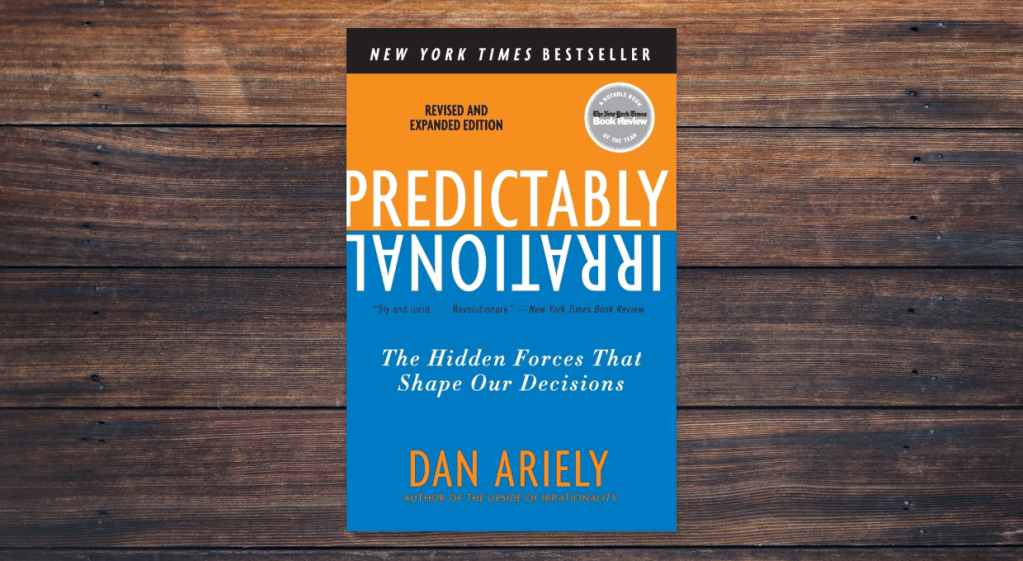
You are not as rational as you think you are. Neither am I. That is the entire premise of Predictably Irrational by Dan Ariely, and for investors, it might be the most useful sentence in any book on this shelf.
Published in 2008 and revised and expanded in 2010, Predictably Irrational is one of the founding texts of popular behavioral economics. Ariely’s argument is simple and devastating: human beings do not make random mistakes. We make the same mistakes, in the same directions, over and over, which means our irrationality is predictable, and therefore manageable, once you see it.
If you have ever bought a stock at the top because everyone else was buying, sold at the bottom because the pain got unbearable, or held a loser for years because admitting the mistake felt worse than the loss, this book is about you.
Book Summary
Predictably Irrational walks through a series of experiments, most of them run by Ariely and his colleagues on college students, that expose the hidden forces shaping our decisions. Each chapter takes one force, demonstrates it with a clever experiment, and shows how it leaks into everyday life. The throughline: standard economics assumes we are rational calculators, but we are emotional, comparative, social creatures shaped by context in ways we never notice. The good news is that the patterns are consistent enough to study, and once you know the traps, you can design around them.
Who is Dan Ariely?
Dan Ariely is the James B. Duke Professor of Psychology and Behavioral Economics at Duke University, and one of the best-known popularizers of behavioral economics alongside Daniel Kahneman and Richard Thaler. Predictably Irrational was a New York Times bestseller, and Ariely went on to write several follow-ups, including The Upside of Irrationality and The Honest Truth About Dishonesty.
His interest in the subject was personal: as a teenager in Israel, severe burns put him in hospitals for years, where he became fascinated by how irrationally people behave around pain and decisions. That experience became a research career, and Predictably Irrational is its most readable product.
Lessons From Predictably Irrational
The book is organized around a handful of big ideas. Here are the ones that matter most to investors.
Anchoring and arbitrary coherence. The first number you encounter sets the reference point for everything after it, even when the number is meaningless. Students who wrote down the last two digits of their Social Security numbers before bidding on items bid higher when their digits were higher. Everyone knew the digits were random, and it still worked. Now think about stock prices: the 52-week high is an anchor, and the price you paid is an anchor. Your brain treats them as meaningful reference points, quietly distorting every buy and sell decision. This is why having a valuation framework matters more than having a price target.
The zero-price effect. “Free!” is not just a low price. It is an emotional trigger that shuts down rational comparison. People will choose a free item they do not need over a nearly-free item that is objectively better. Investors do this too: free trades made everyone trade more, and “zero commission” is not zero cost if it turns you into a hyperactive trader. The price of free is your attention and your discipline.
Social norms vs. market norms. The moment money enters a relationship, generosity evaporates and everything becomes transactional. Ariely’s experiments show people will work harder for a favor than for small amounts of cash, because cash moves the interaction into market norms. For investors, the lesson is about advisors, newsletters, and “free” stock tips: once someone is paid to influence your decisions, treat their advice as a market transaction, which it is.
The decoy effect. When choosing between two options, adding a third option that is clearly worse than one of them makes that one look much more attractive. Marketers use this constantly in pricing tiers. In investing, watch for it in fund marketing: the expensive, mediocre fund exists partly to make the slightly-less-expensive one look like a deal. Compare every investment against the alternative of buying the index, not against the decoy sitting next to it.
Ownership and the endowment effect. We overvalue what we own: people demand far more to sell an item they were given than they would pay to buy it. This is the reason investors hold losing positions for years. The stock in your portfolio is not worth more than the identical stock in someone else’s. If you would not buy it today at today’s price, you should not own it today. The endowment effect is the single most expensive bias in this book for a stock picker.
Expectations shape experience. What you expect to taste, feel, or earn changes what you actually experience. Price tags change how much people enjoy wine, and reputation changes how much investors trust a stock. Be skeptical of your own enthusiasm: some of what you “see” in a beloved company is your expectations doing the seeing.
The pain of paying and procrastination. Paying hurts, and we procrastinate on anything with upfront costs and delayed benefits. Ariely’s chapter on self-control, with its experiments on deadlines, applies directly to rebalancing and tax-loss harvesting, the portfolio maintenance investors put off forever. His finding: pre-commitment beats willpower. Automate the good decisions so your future self cannot negotiate out of them.
Work through Predictably Irrational one chapter at a time; it rewards a slow read.
Criticisms of the Book
The fair criticisms of Predictably Irrational have grown louder since it was published, and they deserve a hearing. The biggest is the replication crisis in behavioral economics and psychology more broadly: a number of famous findings in the field have failed to replicate when other researchers tried to reproduce them. Not every experiment in this book has been re-run, and readers should treat individual study results as suggestive rather than settled, even when the broader patterns hold up.
More specifically, questions were raised in 2021 about the data behind a 2012 paper Ariely co-authored on honesty, after an analysis suggested the data had been fabricated. Ariely denied any wrongdoing, said the data had come from an outside company, and noted that he had not collected it himself. The episode does not directly concern this book’s experiments, but it is part of the honest accounting a review should give: some of the shine has come off the field’s early certainty.
A smaller criticism: the experiments were mostly run on college students, and the leap from lab games to real financial decisions is sometimes bigger than the storytelling admits. Take the insights as directionally true, not as laws of physics.
Who is This Book For?
Predictably Irrational is for any investor who wants to understand their own worst enemy: themselves. It pairs naturally with Kahneman’s Thinking, Fast and Slow, the deeper and more rigorous treatment of the same territory, and with Richard Thaler’s Misbehaving, which we reviewed here. If you have read those, this book is the most entertaining entry point of the three, and the experiments make the biases stick in a way abstractions do not.
It is also for anyone who designs choices for a living: marketers, managers, policymakers. But on this site, the audience is investors, and the pitch is simple. Your portfolio’s returns are downstream of your decisions, and your decisions are downstream of biases you cannot feel operating. This book names them. It also sits comfortably on our list of the 7 Best Books on the Psychology of Money.
It is not for readers who want a systematic investing framework. This is a book about how minds work, not about how to value companies.
Final Thoughts
Predictably Irrational will not make you rational. Nothing will. What it does is replace your vague sense that “emotions affect investing” with a specific catalog of traps, each with a name and a countermeasure. Once you can name them, you start catching them in your own brokerage account.
The replication concerns are real, and this review would be dishonest without them. But the book’s core message has survived the field’s troubles intact: your mistakes are not random, they are systematic, and systematic mistakes can be managed. For an investor, that is one of the highest-leverage insights in print.











You must be logged in to post a comment.