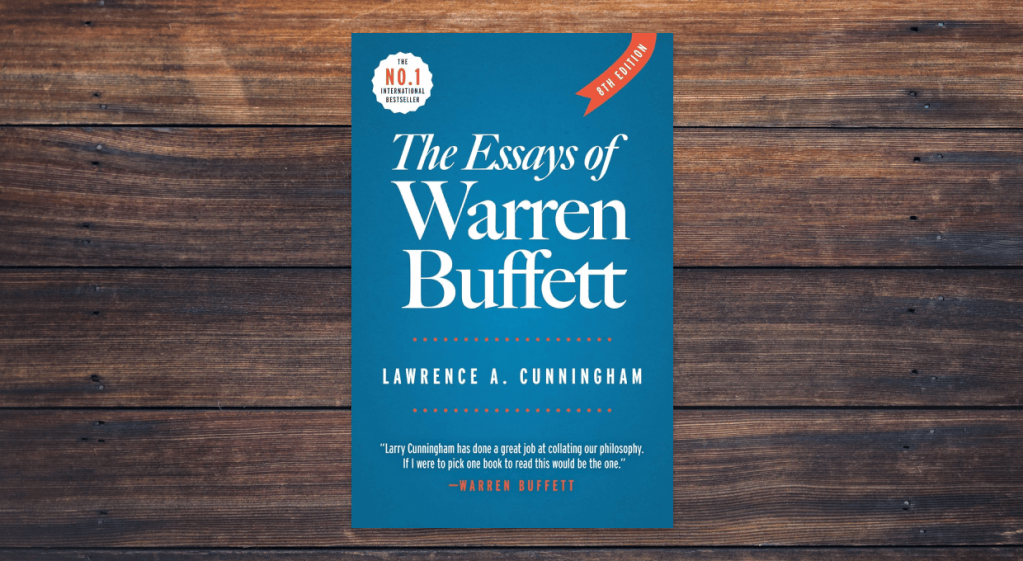
There are two ways to absorb Warren Buffett’s thinking. You can read six decades of Berkshire Hathaway annual shareholder letters, hunting for the signal in hundreds of pages — or you can read The Essays of Warren Buffett, where law professor Lawrence A. Cunningham has done the hunting for you. He selected the essential passages from Buffett’s letters and arranged them thematically into seven sections, turning a sprawling archive into a single coherent curriculum on governance, investing, and accounting.
Book Summary
Published in 1997 and updated through multiple editions (the current printing is the eighth), The Essays of Warren Buffett is not a book Buffett sat down to write. It is a compendium of his Berkshire Hathaway chairman’s letters to shareholders, curated and introduced by Cunningham, organized between Buffett’s own Prologue and Epilogue into seven sections: Corporate Governance; Corporate Finance and Investing; Alternatives to Common Stock; Common Stock; Mergers and Acquisitions; Accounting and Valuation; and Accounting Policy and Tax Matters.
The genius of the arrangement is that it converts decades of annual letters — each one written to address that year’s events — into a durable philosophy. Buffett’s core ideas recur across the letters because he returns to them every year: the “institutional imperative” that makes managers copy their peers like lemmings, the obligation of a CEO to speak to owners plainly and directly, the difference between price and value, and his famous skepticism of Wall Street’s accounting games. Reading them arranged by theme, you see the system behind the anecdotes.
Who is Warren Buffett?
Warren Buffett is the chairman and CEO of Berkshire Hathaway, the conglomerate he took control of in the 1960s and built into one of the most valuable companies on earth. Known as the “Oracle of Omaha,” he is the most famous investor in history — a student of Benjamin Graham, the father of value investing, and the longtime partner of Charlie Munger. His annual shareholder letters, which The Essays of Warren Buffett draws from, are among the most widely read documents in business: plain-spoken, funny, and ruthlessly honest about his own mistakes. Cunningham is a law professor at George Washington University who has written extensively on corporate governance, and whose introductions to each section add legal and economic context Buffett never needed to explain to his own shareholders.
Lessons From The Essays of Warren Buffett
1. Owners are entitled to hear directly from the CEO. In his Prologue, Buffett argues that the annual letter should come “from the fellow you are paying to run the business,” not from a PR department. Candor is the organizing principle of the whole book: he confesses bad decisions, explains what he learned, and tells shareholders exactly how he evaluates the business. It’s a standard almost no other CEO meets — and a template for how to think about any management team you invest with.
2. Beware the institutional imperative. Buffett’s most quoted management concept is the “institutional imperative”: the tendency of companies to resist change, absorb available funds, and mindlessly imitate competitors. The result is what he calls a lemming-like, follow-the-pack mentality. The lesson for investors is to watch what management does with your cash — and for anyone running a business, to build a culture that resists the imperative’s gravity.
3. Price is what you pay; value is what you get. The investing sections distill Graham-style value investing into Buffett’s own voice: buy wonderful businesses at fair prices rather than fair businesses at wonderful prices, stay inside your circle of competence, demand a margin of safety, and let temperament — not intellect — be your edge. Mr. Market will offer you prices every day; your job is to transact only when the price is absurdly in your favor.
4. Reported earnings are a fiction; learn to read the economics. The accounting sections are the book’s hidden treasure. Buffett introduces concepts like “owner earnings” — reported earnings plus depreciation, minus the capital expenditures a business actually needs — and argues that book value is a poor proxy for intrinsic value. He savages EBITDA as a misleading metric and warns that Wall Street’s numbers are designed to flatter management, not inform owners. For anyone who reads financial statements, these essays are a masterclass in seeing through them.
5. Most acquisitions destroy value. Buffett is famously skeptical of mergers: managers overpay, investment bankers get paid regardless, and issuing shares to buy companies dilutes the owners who are supposedly being served. Berkshire’s own acquisitions worked because they were rare, disciplined, and paid for sensibly. The lesson generalizes: be deeply suspicious of any CEO whose growth strategy is buying other companies.
Criticisms of the Book
The most common complaint is that there’s no new material here. Every word in The Essays of Warren Buffett comes from letters that Berkshire publishes for free online — you’re paying for Cunningham’s curation, introductions, and organization, not for new Buffett content. Fair enough, though the curation is genuinely valuable: finding these ideas across decades of PDFs is its own project.
Second, some sections show their age. Essays written in the 1980s and 1990s discuss companies, tax regimes, and accounting rules that have since changed or vanished, and the accounting-heavy back third of the book is slow going for anyone who isn’t already comfortable reading financial statements. Finally, the organization is Cunningham’s, not Buffett’s — a few readers prefer the chronological approach of simply reading the letters in order. These are quibbles, not disqualifiers.
Who is This Book For?
This book is for the investor who wants Buffett’s philosophy in one organized volume instead of scattered across decades of shareholder letters. It’s essential reading for value investors, and surprisingly useful for managers and board members — the governance sections read like a manual for running an honest company. If you’ve already read The Intelligent Investor and The Warren Buffett Way, this is the natural next step: the primary source, arranged for study. It’s not for beginners looking for a step-by-step investing guide; Buffett assumes you’re willing to think.
Final Thoughts
The Essays of Warren Buffett is the closest thing to a Buffett textbook that exists — written by the man himself, organized by someone who understands what he’s saying. The ideas in it — the institutional imperative, owner earnings, the owner-oriented CEO — will change how you read every annual report you ever open. For a book that costs less than a single share of almost anything, the return on investment is absurd.











You must be logged in to post a comment.