Book Summary
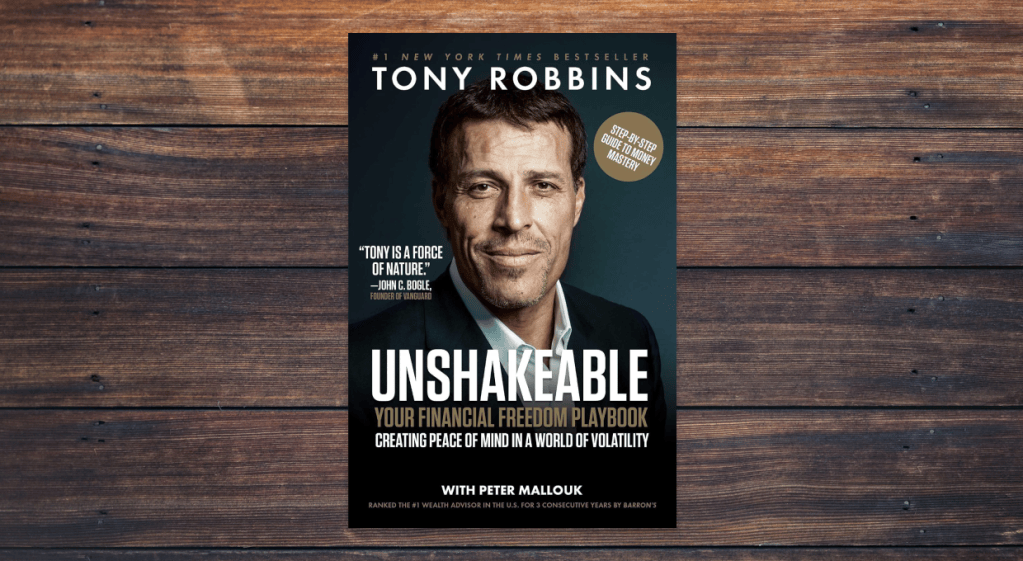
Unshakeable: Your Financial Freedom Playbook is Tony Robbins’s follow-up to his bestseller Money: Master the Game, and it has one job: to convince you that stock market crashes are normal, survivable, and no reason to abandon your plan. Where Money: Master the Game ran nearly 600 pages, Unshakeable delivers the core of Robbins’s investing philosophy in a shorter, more focused read. Co-written with financial advisor Peter Mallouk, the book blends market history, portfolio mechanics, and investor psychology into a playbook for staying calm when everyone else is panicking.
Who is Tony Robbins?
Tony Robbins is one of the world’s best-known performance coaches and motivational speakers, with a career spanning four decades, dozens of bestselling books, and a massive seminar business. His first finance book, Money: Master the Game, was the result of interviews with more than 50 legendary investors, including Warren Buffett, Jack Bogle, and Ray Dalio. In 2016, Robbins joined the wealth management firm Creative Planning as chief of investor psychology, a role that puts his own financial advice business directly in the industry he writes about. Unshakeable was co-written with Peter Mallouk, the president of Creative Planning, and distills the practical investing core of Robbins’s earlier, longer book.
Lessons From Unshakeable
Corrections are a feature, not a bug. Robbins’s central claim is that market downturns are not emergencies but regular weather. Historically, corrections of 10 percent or more happen roughly once a year, and bear markets arrive every few years, yet the market has always recovered and gone on to new highs. The investor who understands this in advance is not blindsided when it happens.
Winter is coming, so prepare for it. Robbins borrows the phrase to make a simple point: you would not be shocked by snow in January, so do not be shocked by a bear market in stocks. The book argues for building a portfolio that can survive winter before winter arrives, through diversification across asset classes and a mix of investments that do not all move together.
Fear is the real portfolio killer. A recurring theme in Unshakeable is that the media profits from panic, and panicking investors sell low and buy high. Robbins presents data showing that missing just the market’s best days can devastate long-term returns, which is his case for staying invested through downturns rather than trying to time them.
Four principles for an unshakeable portfolio. The book organizes its advice around four ideas: do not lose money, seek asymmetric risk and reward, be tax efficient, and diversify. In practice this means owning low-cost index funds, rebalancing regularly, minimizing fees that compound against you over decades, and keeping taxes low through the right account types.
Get a fiduciary, or manage it yourself cheaply. Robbins warns that many financial advisors are not legally required to act in their clients’ best interest. His advice is to either hire a true fiduciary advisor or skip the advisor entirely and build a simple, low-cost portfolio on your own.
Criticisms of the Book
The most common criticism of Unshakeable is that it is essentially a condensed Money: Master the Game. Readers of the earlier book will find little that is new. The core advice, index funds, diversification, low fees, stay the course, is the same conventional wisdom championed by Jack Bogle decades ago, repackaged with Robbins’s motivational energy.
There is also a conflict-of-interest question worth knowing about. Robbins is a partner at Creative Planning, the firm run by his co-author, which profits from the wealth management industry the book describes. That does not make the advice wrong, but it is context a skeptical reader should have.
Finally, the book’s promise of “upside without the downside” is marketing language, not a real feature of any portfolio. No mix of assets eliminates risk, and the book’s confidence can read as overselling certainty in a domain where uncertainty is the whole game.
Who is This Book For?
Unshakeable is for the investor who knows the basics but gets nervous when markets fall, and for beginners who want the core of Money: Master the Game without committing to 600 pages. It is also a natural read for Robbins fans who respond to his coaching style. Experienced investors who have already internalized buy-and-hold indexing will find little they have not seen before.
Final Thoughts
Unshakeable does not contain a secret. Its value is narrower and more honest than the title suggests: it is a well-organized argument for behaving rationally during market crashes, backed by enough history to make the case stick. If you already own Money: Master the Game, you can probably skip it. If you want the short version of Robbins’s investing philosophy, or you need a steadying voice the next time the market drops 20 percent, this is the book to reach for.











You must be logged in to post a comment.